How to Start a Neighborhood Child Safety Initiative
Most neighborhoods have the goodwill to protect their children but lack the structure to act on it. This step-by-step guide covers everything from risk assessment to communication systems, safe house networks, and modern child identification tools - so any parent can build a lasting neighborhood safety program from scratch.
Quick Answer
To start a neighborhood child safety initiative, begin with a walkthrough risk assessment of your area, then recruit four to six co-organizers from different community segments. Set up a communication channel with clear emergency protocols, establish designated safe houses on key child routes, host an annual child safety fair with ID kit distribution, and build in annual recertification to sustain the program long-term.
Every neighborhood has the raw ingredients for a powerful child safety network: parents who care, neighbors who watch out for each other, and a shared stake in the children who play on the same streets and walk the same routes to school. What most neighborhoods lack is the activation - someone taking the first step to turn goodwill into organized, practical preparation. That step does not require a grant, a formal committee, or a background in emergency management. It requires one parent willing to start a conversation.
The need has never been clearer. In 2024, the National Center for Missing and Exploited Children (NCMEC) assisted law enforcement with 29,568 missing child cases. Ninety-one percent of those children were ultimately recovered - a testament to rapid community response, improved communication systems, and neighbor-level vigilance. But recovery is not the same as prevention, and for every child who is found, the window of time between disappearance and identification is filled with risk. One in seven missing children reported to NCMEC are identified as trafficking victims. Those numbers are not abstract. They are the cost of communities that are not yet organized.
The Block Parent Program, once a backbone of neighborhood child safety, has declined from roughly 500,000 registered homes to around 25,000 due to volunteer fatigue and the collapse of door-to-door recruitment structures. The informal safety net that generations of children relied on is thinner than it has ever been. Rebuilding it - with modern tools, realistic expectations, and a sustainable community structure - is one of the most impactful things a parent can do for the children in their neighborhood.
This guide is a step-by-step playbook for doing exactly that.
Why Neighborhood-Level Safety Matters More Than Ever
Institutional child safety programs operate at scale. They write policies, train teachers, run national campaigns, and coordinate with law enforcement. All of that work matters enormously. But it operates at a distance from the specific block, park, and school-walk path where your child actually lives. The gap between a national campaign and what happens on your street on a Tuesday afternoon is a gap only neighbors can close.
Research from the field of public health consistently shows that behavior change is most durable when it is reinforced by social norms within a person's immediate community. A school newsletter about child identification goes unread. A neighbor saying "we've done this for our kids - want to hear about it?" gets acted on by the weekend. The horizontal trust between parents is a resource that no institution can replicate.
The Collapse of the Traditional Neighborhood Safety Net
The Block Parent Program was founded in Canada in 1969 and spread across North America as a visible, neighborhood-based system of safe havens for children. At its peak, more than 500,000 homes displayed the Block Parent sign - a signal that any child in distress could knock on that door for help. Participation has fallen to roughly 25,000 homes nationwide, a 95% reduction driven by volunteer fatigue, changing neighborhood social structures, and the decline of the door-to-door recruitment infrastructure that built the program.
The result is a generation of children who cannot rely on the informal safety net their parents had. The houses are still there. The willingness to help is still there in most communities. What is gone is the organizing structure and visible signal system that made the network legible to children and parents alike.
What Modern Research Says About Neighbor Involvement
A study published in Injury Prevention (BMJ) found that neighborhood social cohesion - residents' sense of trust and mutual support - is independently associated with lower rates of child injury and improved safety outcomes. Neighborhoods where residents know each other, communicate regularly, and have shared norms around child safety are measurably safer for children, not just on paper but in incident rates.
The National Crime Prevention Council (NCPC) has documented similar findings in community crime prevention research: organized neighborhood safety programs reduce both the incidence of crime and the response time when incidents occur. The same principles apply to child safety specifically. A neighborhood that has done the work in advance - established communication trees, identified safe houses, documented child identification information - performs dramatically better when something goes wrong.
Step 1: Assess Your Neighborhood's Specific Risks
Before you recruit a single neighbor or plan a single event, spend time understanding the specific risk landscape of your area. Generic advice about child safety is everywhere. What makes a neighborhood initiative genuinely effective is that it addresses the specific routes, locations, and patterns that affect your children.
Map Your Physical Environment
Walk your neighborhood as a safety audit. Bring a notebook or use your phone to document:
- School routes. Which paths do children actually use? Are there stretches with poor visibility, overgrown hedges, blind corners, or long gaps between houses? Who lives along those routes?
- Parks and play areas. Which parks do children use most? What are the entry and exit points? Are there areas of the park not visible from common gathering spots?
- Transit points. Where do children wait for buses? Are there designated crossing points that children actually use versus the crosswalks that exist on paper?
- Known gathering spots. Where do children congregate after school - parking lots, convenience stores, playgrounds? Are adults present in those spaces?
This is not about cataloguing danger for its own sake. It is about knowing your terrain well enough to make practical decisions: which blocks most need Block Parent participation, which park needs an adult presence during peak hours, where signage or lighting improvements could be advocated for.
Understand Your Population's Specific Needs
Child safety is not one-size-fits-all. A neighborhood with a high proportion of very young children faces different challenges than one with mostly middle schoolers. Families with children who have developmental differences, communication challenges, or medical conditions face identification and response challenges that need specific planning. Neighborhoods with high rental turnover need different communication strategies than close-knit long-term-resident communities.
As you begin talking to neighbors, listen for these specifics. The initiative you build should reflect the actual children who live there, not a hypothetical average.
Talk to Local First Responders
Your local police department and fire station are valuable early partners and an important source of neighborhood-specific information. Ask if there is a community liaison officer. Request any publicly available incident data about the types of child safety incidents in your area. Find out what resources they offer to community groups - many departments have materials, training, or personnel available for neighborhood safety meetings at no cost.
The NCPC's community crime prevention resources include a framework for this kind of first-responder partnership that applies directly to child safety initiatives.
Step 2: Build Your Core Group
A neighborhood child safety initiative built by one person burns out quickly. The goal of this step is to find four to six co-organizers who share the work and represent the breadth of the community.
Who to Recruit First
Start with people you already know and trust, but think deliberately about who brings different access points to the neighborhood:
- A parent active in the school PTA or parent-teacher council
- A neighbor who has lived in the area for many years and knows people across multiple blocks
- Someone connected to a faith community or cultural organization that many neighborhood families belong to
- A parent with a child who has a disability or medical condition, who can represent those needs in planning
- A younger or newer resident who can bring energy and connections to families who have recently moved in
You do not need formal roles at this stage. You need a small group of people willing to each do one thing: reach out to their existing circles. Each of your five co-founders probably knows twenty families the others do not. That overlap is the seed of your network.
The First Meeting
Keep the first meeting short, specific, and low-stakes. A kitchen or backyard works better than a community room that requires scheduling. Your agenda should be simple:
- Share what you learned in your neighborhood risk assessment
- Explain what you want to build and what it is not (not a surveillance network, not a replacement for police, not a time-intensive commitment for most participants)
- Identify two or three concrete first actions the group can commit to before the next meeting
The goal of the first meeting is not to launch a program. It is to confirm that the group is real and willing to work together.
Framing That Works
One of the most common obstacles to recruiting neighborhood safety volunteers is the perception that it will be time-consuming, politically complicated, or anxiety-inducing. Counter this directly in your framing:
- Frame it as preparation, not fear. "We want to make sure we have the information we'd need if something happened" lands differently than "we need to protect our kids from danger."
- Emphasize the positive community-building aspects. Block parties, walking school buses, and community check-in systems have benefits beyond safety.
- Be honest about the time commitment. A realistic ask - two hours a year for most participants, more for the core group - is more likely to get a yes than an open-ended commitment.
Step 3: Set Up a Communication System
The most critical function of a neighborhood child safety network is rapid, reliable communication. When something goes wrong, the difference between an hour and five minutes of neighborhood awareness can determine the outcome.
Choose a Primary Channel
Pick one channel and make it the default. Common options:
- Neighborhood apps (Nextdoor, Signal groups, WhatsApp groups). These work well for neighborhoods with high smartphone adoption. Their limitation is that not everyone joins, and notification fatigue is real.
- Email lists. Lower friction for people who do not want another app. Less immediate for urgent alerts.
- Text tree. A traditional call/text tree where each person is responsible for notifying a specific set of neighbors. Reliable, does not require any particular platform, and works when internet is slow.
Most successful programs use a layered approach: one primary digital channel for routine communication and an urgent text/call protocol for genuine emergencies. Document the difference explicitly so that an "AMBER Alert forwarded to the group" does not get the same response as "I cannot find my daughter and she was last seen at the park at 3pm."
Define Your Communication Protocols
Before an incident happens, establish:
- What information triggers an immediate group alert (missing child, suspicious person near children, immediate safety threat)
- What goes in the alert (description, last known location, time, who to contact)
- Who has authority to send an emergency alert to the full group
- How to distinguish between "urgent" and "informational" messages
Post the protocol as a pinned message in your group. Review it at your annual meeting. Make sure every participant knows where to find it.
Build the Contact Directory
Compile a neighborhood directory that includes, at minimum: name, address, primary phone number, and whether the household has children at home. For households with children, note any medical or communication needs relevant to an emergency response. Keep this directory accessible to all core group members and update it annually.
Privacy is a reasonable concern here. Make participation opt-in, explain exactly who has access, and never publish the directory publicly. Most parents will happily share basic contact information when they understand the purpose.
Step 4: Create Physical Safety Infrastructure
Communication systems are only as good as the information flowing through them. The most underbuilt part of most neighborhood safety programs is the physical identification infrastructure for children themselves. This is the layer that makes the difference when a child is found separated from their family.
Re-establish Safe Houses
The Block Parent model still works - it just needs to be rebuilt with modern recruitment. Identify households on key routes and at key intersections that are willing to be designated safe havens for children. A safe house is simply a home where a child can knock if they feel unsafe, are lost, or need to reach a parent.
Make the designation visible. Create simple printed signs for safe houses. Brief safe house volunteers on basic protocol: how to contact parents from the neighborhood directory, how to keep a child calm while waiting, when to call 911. The NCMEC provides community resources that include training materials for exactly this kind of program.
Create Child Identification Records
Work with your core group to encourage every family in the network to maintain an up-to-date child identification file. The National Child ID Program provides fingerprint and identification kits that can be distributed at community events at no cost. Every family file should include:
- A current, high-resolution photograph (updated at least annually)
- Physical description: height, weight, hair and eye color, distinguishing features
- Fingerprints
- Any medical conditions, medications, or communication differences that a first responder would need to know
- Emergency contact information
Equip Children for Identification at the Point of Separation
A completed ID file in a parent's drawer helps law enforcement after a child is reported missing. It does not help the neighbor who finds an unaccompanied three-year-old at the edge of a park and needs to know whose child this is right now. The identification gap at the moment of separation is where most reunification delays occur.
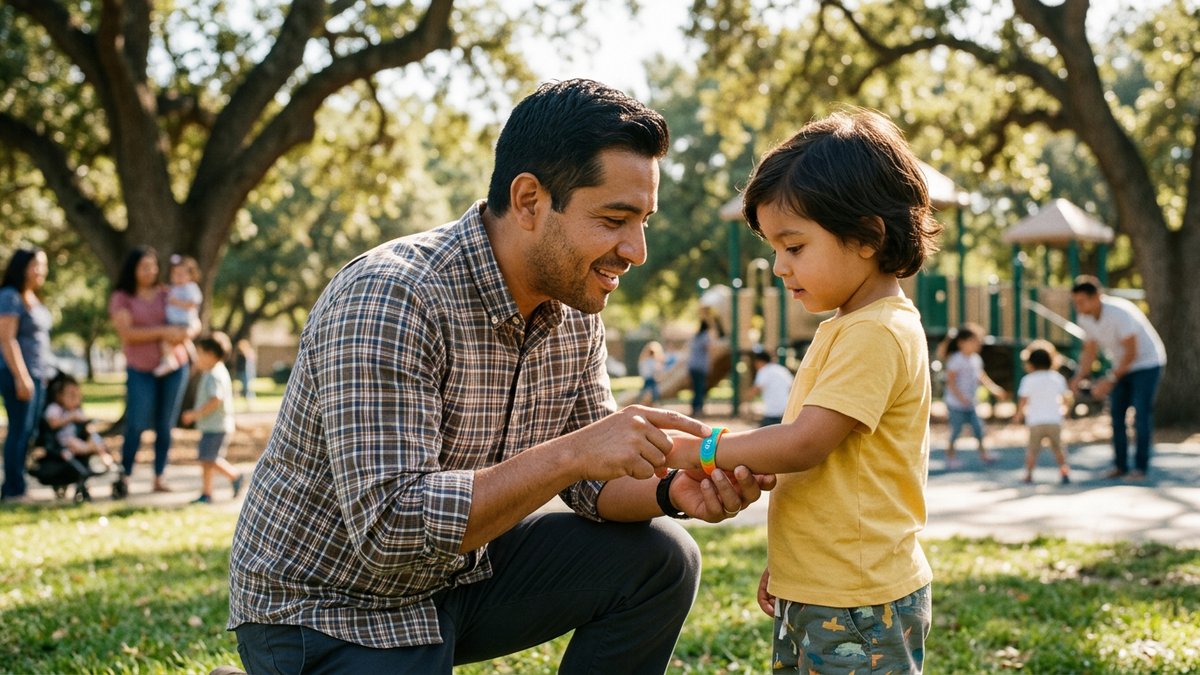
Modern NFC identification tools close this gap directly. A child wearing an NFC-enabled wristband can be identified by any person with a smartphone - a neighbor, a park-goer, a store employee - within seconds, without downloading an app, without cellular signal, and without the child needing to communicate anything. The person who finds the child simply taps their phone to the wristband and sees the child's name, medical alerts, and emergency contact information immediately.
When you equip an entire neighborhood's children with this capability, you transform every adult in the community into a potential first responder. The neighbor who sees an unaccompanied child at the edge of a park does not need to guess, does not need to involve police unnecessarily, and does not need the child to communicate. They scan, they see the name and number, they call the parent. Reunification in minutes rather than hours.
Set Up Physical Signage
Visible markers communicate program existence to children and strangers alike. Safe house signs let children know where to go. Program signs at neighborhood entry points signal that this is an organized community that watches out for its children. Work with your municipality to understand any permitting requirements for signage in public spaces.
Step 5: Run Regular Community Safety Events
A communication system and an ID infrastructure are only effective if neighborhood families are enrolled in them. Events are your enrollment mechanism - and done well, they build the social cohesion that makes the whole program stronger.
The Annual Child Safety Fair
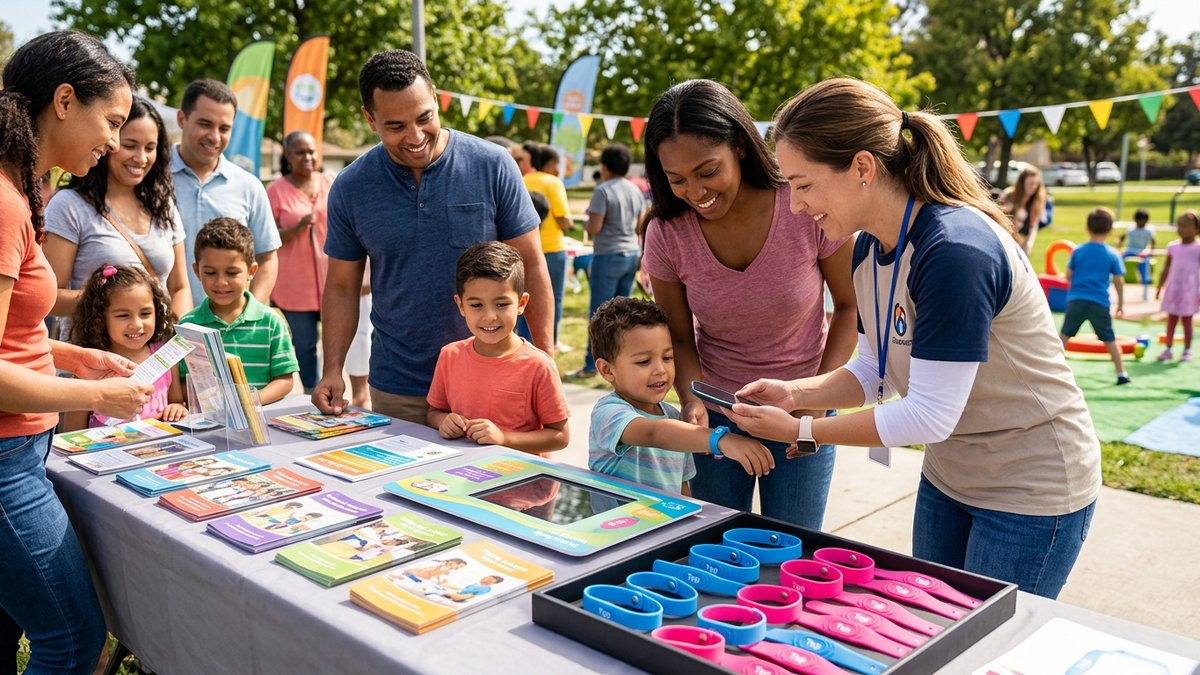
Once a year, host a dedicated child safety event. This can be combined with an existing neighborhood gathering like a block party or back-to-school event. The agenda should include:
- Child ID kit distribution and fingerprinting station (the National Child ID Program provides materials at no cost through childidprogram.com)
- Demonstration of modern identification tools including NFC wristbands
- Introduction of safe house volunteers and how to use them
- Distribution of the neighborhood directory and review of communication protocols
- A brief, age-appropriate activity for children about body safety and asking for help
Keep it under two hours and make it genuinely fun. If children have a positive association with the event, they will talk about it and parents will come back next year.
The Walking School Bus
A walking school bus is one of the most effective and sustainable neighborhood child safety programs: a group of children who walk to school together along a fixed route, supervised by parent volunteers who rotate through the schedule. Research from the Safe Routes to School National Partnership shows that walking school buses increase physical activity, reduce car traffic, and significantly improve safety for children on school routes.
Starting one requires:
- Mapping the existing routes children walk to school
- Recruiting a core set of parents willing to volunteer two to three times per month per route
- Establishing pickup and dropoff points and times
- Communicating the route and schedule to all interested families
Walking school buses are particularly powerful for routes with identified gaps in safe house coverage, since the group format provides supervision without requiring physical infrastructure at every point.
Halloween and High-Volume Events
Halloween is the single highest-participation outdoor event for children in most neighborhoods - and one of the highest-risk for separation. A child in a mask who cannot verbalize their address or parent's phone number, in a crowd of strangers in the dark, is a genuine identification challenge.
Organize a neighborhood-wide Halloween safety protocol: encourage all participating families to equip children with visible identification (NFC wristbands are designed for exactly this), establish designated safe gathering points, and have core group members stationed along popular routes. The same principle applies to Fourth of July gatherings, community festivals, and other high-attendance events.
Monthly or Quarterly Check-ins
Beyond the annual fair, maintain engagement through low-commitment touchpoints. A monthly message in the neighborhood group with one safety tip, one reminder about the directory, and one upcoming event keeps the initiative present without requiring anything major from volunteers. Quarterly in-person gatherings - even casual ones at a park - sustain the social connections that make the network function.
Step 6: Evaluate and Sustain the Program
The graveyard of neighborhood safety initiatives is full of programs that launched with energy and faded within eighteen months. Sustainability requires deliberate structure from the beginning.
Track Simple Metrics
You do not need complex reporting, but you do need to know if the program is growing or shrinking. Track annually:
- Number of households enrolled in the communication system
- Number of designated safe houses, with geographic coverage map
- Number of families with completed child ID files (estimated through event attendance)
- Number of incidents where the network was activated and what happened
Reviewing these numbers at your annual meeting gives the group a sense of progress and highlights where investment is needed.
Rotate Leadership
No single person should be indispensable to the program. Formally rotate the coordinator role every one to two years. Document all processes - communication protocols, event planning checklists, contact directory maintenance procedures - so that a new coordinator can step in without losing institutional knowledge.
The Community Policing Consortium, under the Department of Justice, has published guidelines on volunteer program sustainability that are directly applicable to neighborhood safety groups. The key insight: programs that formalize processes and distribute responsibility outlast programs built around individual champions.
Connect with Existing Programs
You do not need to build in isolation. Connect your neighborhood initiative with:
- Your city's or county's existing neighborhood watch or community safety programs
- The local police community liaison office
- Your school district's safety coordinator
- National programs like NCMEC's community outreach resources
These connections provide resources, credibility, and backup support without requiring your program to be subsumed into a larger bureaucracy.
Annual Recertification Events
Once a year, use your child safety fair as a recertification moment. Update child ID files. Renew safe house commitments. Re-establish communication protocols. Welcome new families who have moved into the neighborhood. Refresh the contact directory.
The rhythm of annual recertification is what converts a one-time initiative into a permanent neighborhood institution.
The Neighborhood Child Safety Toolkit
Use this reference checklist as you build your program. Each item is actionable at the neighborhood level without institutional resources or formal authority.
Foundation Items (Complete in First 90 Days)
- Complete a neighborhood walk-through safety audit
- Recruit four to six co-organizers representing different community segments
- Establish a primary communication channel with clear emergency protocols
- Build an opt-in neighborhood contact directory
- Identify initial safe house volunteers on key child routes
Identification Infrastructure
- Distribute child ID kit materials at a community event
- Establish annual update cadence for child ID files
- Introduce modern identification tools (NFC wristbands) at community demonstrations
- Equip safe house volunteers with basic identification response protocol
- Create visible safe house signage on key routes
Ongoing Programming
- Annual child safety fair with ID kit distribution
- Walking school bus program on highest-traffic school routes
- Halloween and high-volume event safety protocol
- Monthly light-touch communication in neighborhood channels
- Quarterly in-person connection events
Sustainability Structure
- Documented processes for all key program functions
- Formal leadership rotation schedule
- Annual program metrics review
- Connection to local police community liaison
- Integration with existing neighborhood watch or municipal safety programs
The initiative that starts as one parent's conversation at a backyard gathering and becomes a neighborhood institution that protects children for years is not an unusual outcome. It is the norm when the foundation is built deliberately. Start with the risk assessment. Find your co-organizers. Build one system at a time. The network that you build today is the reason a child comes home quickly tomorrow.

TapTap Buddy Team
Our team of child safety experts, parents, and technology specialists is dedicated to creating innovative solutions that keep children safe. With backgrounds in emergency response, pediatric care, and smart technology, we bring real-world experience to every article.
View all articles