The Grandparent's Guide to Modern Child Safety Tech
Grandparents provide childcare for millions of American children every week, yet most child safety technology is designed for app-savvy parents, not for the caregivers who actually need it in the moment. This guide covers the real safety risks grandparents face, which modern tools actually work without tech complexity, and how to build a safety system that protects grandchildren while giving both generations confidence.

Quick Answer
Grandparents caring for grandchildren should prioritize layered safety tools that work without apps or accounts. An NFC identification wristband (set up by parents, worn by the child) lets any bystander or first responder access emergency contacts and medical info instantly. Pair this with a written emergency card in the grandparent's wallet, a current photo on their phone, and a practiced meeting-point plan for crowded venues.
Every week, millions of grandparents pick up grandchildren from school, take them to the park, bring them to soccer practice, and navigate busy farmers markets and county fairs with little ones in tow. According to Child Care Aware of America, 42% of working parents rely on grandparents for regular childcare, and roughly 2.5 million children in the United States are being raised primarily by their grandparents. Another 20% of grandparents provide weekly childcare support for families in their community.
That is a staggering number of children whose safety, in thousands of everyday moments, depends on a grandparent being prepared.
Yet the child safety technology conversation almost entirely ignores this reality. App-dependent GPS trackers, subscription-based wearables, and smartphone-integrated monitoring systems are designed for tech-comfortable parents in their twenties and thirties. They assume the caregiver will download an app, maintain an account, monitor a dashboard, and troubleshoot connectivity issues on the fly. For grandparents who are willing and capable caregivers but did not grow up in a world of NFC chips and cellular data plans, this creates a genuine gap between the safety tools available and the safety tools that actually work in practice.
This guide bridges that gap. It is written for grandparents who want to understand the landscape of modern child safety technology, and for parents who want to set their caregiving grandparents up for success without creating a tech support burden. We will cover what the safety risks actually look like in grandparent caregiving contexts, how to evaluate modern ID and monitoring tools honestly, and how to create a safety system that works for everyone, regardless of technical comfort level.
Why Grandparent Caregiving Requires Its Own Safety Conversation
The safety challenges grandparents face are not simply a scaled-down version of what parents face. They are in some ways more acute, and they involve a specific set of factors that mainstream child safety content rarely addresses.
Unfamiliar environments. When parents take children to crowded places, they tend to visit the same locations repeatedly and build familiarity over time. Grandparents often accompany families to events, travel to unfamiliar cities to visit, or take grandchildren on special outings to places they may have never been before. A grandmother taking her seven-year-old grandson to a state fair she last visited thirty years ago is navigating an unfamiliar layout, unfamiliar crowds, and unfamiliar emergency protocols.
Communication gaps in a crisis. A young child separated from their grandparent in a crowd faces a different problem than one separated from a parent. Young children may not know their grandparent's phone number. In the chaos of the moment, a frightened five-year-old may not remember their own last name, let alone their parent's cell number. And the grandparent, searching frantically in a large venue, may not have immediate access to recent photos of the child to share with security staff.
Medical information complexity. Children today are diagnosed with allergies, asthma, autism spectrum disorder, ADHD, and a range of other conditions at higher rates than previous generations. A grandparent stepping in as a caregiver may know in a general sense that a grandchild has a peanut allergy or takes medication, but may not have immediate access to the full details a first responder or emergency room nurse would need.
Technology anxiety as a real barrier. This is not about capability - it is about design. Many grandparents are skilled smartphone users. But when a child is missing in a crowd, no one, regardless of their tech fluency, wants to troubleshoot an app login or navigate an unfamiliar dashboard. Systems that require real-time technological interaction fail under exactly the conditions that matter most.
The Real Risks in Numbers: What the Data Shows About Child Safety Incidents
Understanding the actual risk landscape helps grandparents and parents prioritize where to focus their safety planning.
Separation incidents are by far the most common child safety emergency families face. According to data compiled by Children's Mercy Hospital, the vast majority of child safety incidents in crowded public spaces involve temporary separation rather than abduction. Children wander away in stores, get turned around in theme parks, and lose sight of caregivers in festivals and sporting events. These incidents are frightening and disorienting for children, but they are almost always resolved quickly when bystanders and venue staff have a way to connect the child with their caregiver.
The critical factor is not how quickly a parent can locate the child on a map. It is how quickly someone standing next to the child can identify who the child belongs to and make contact.
Medical emergencies are a secondary but significant concern. When a child with a known allergy or medical condition is in someone else's care, the caregiver's ability to communicate that information accurately to emergency responders can be genuinely life-saving. A child who goes into anaphylaxis at a birthday party, a child who has a seizure at a soccer game, a child with autism who becomes overwhelmed and nonverbal in a stressful situation - in each case, the caregiver's ability to quickly communicate medical context to first responders matters enormously.
Digital safety and screen time concerns are real but distinct from physical safety. For grandparents providing childcare in the home, concerns around unsupervised internet access, screen time management, and contact with strangers online are increasingly relevant. These require different tools and strategies than physical identification and location.

The Modern Child Safety Tech Landscape: An Honest Overview for Grandparents
The market for child safety technology has grown dramatically over the past decade. Walking into any conversation about child safety tech without a framework for evaluating these tools is overwhelming. Here is an honest breakdown of what is actually available.
GPS Trackers: What They Do and What They Do Not Do
GPS trackers for children are wearable or portable devices that transmit the child's real-time location to a parent's smartphone. They have genuine value in certain situations, particularly for parents of older children or children with conditions that make wandering a specific risk.
But GPS trackers have meaningful limitations that are rarely discussed in product marketing. They require active cellular service, which means they fail in areas with poor signal coverage. They require battery management - a device that has not been charged will not transmit location data at the moment it is needed most. Most importantly, they give information to the parent but give nothing to the person standing next to a lost child. A stranger who finds a child wearing a GPS tracker has no way to access emergency contact information, no way to know the child's name, and no way to reach the child's family.
For grandparent caregivers, GPS trackers create an additional layer of complexity. They typically require an account, an app, and active monitoring. The grandparent may not have the app. The account may be set up under the parent's login credentials. In the moment of a separation, coordinating between a worried grandparent and a parent who is at work and suddenly receiving a location ping is a system that has many potential points of failure.
Smartwatches for Kids: The Pros and Cons
Children's smartwatches like the GizmoWatch and similar products offer two-way calling, location sharing, and in some cases limited app access. For children who are old enough to manage a wearable device (generally age seven and up), these can be genuinely useful.
The limitations are similar to GPS trackers: subscription fees, battery requirements, and the need for the child to actively use the device. Many young children do not reliably understand how to use a smartwatch in a stressful situation. And like GPS trackers, they provide no information to bystanders.
Traditional ID Methods: What Still Works
Before any of these technologies existed, families relied on a combination of approaches that still have real value. Teaching children their full name, their parent's phone number, and their home address remains foundational. The National Center for Missing & Exploited Children recommends that children be able to recite at least one parent's phone number by memory from around age five.
Temporary tattoo-style ID stickers for very young children at crowded events have been a popular low-tech solution for years. They work well for a single day but fade, smear, and cannot be updated once applied.
Emergency contact cards in backpacks or pockets are useful but only reach someone if that person thinks to search the child's belongings, which is not always intuitive in a crowded public space.
NFC Identification Wristbands: The Grandparent-Proof Option
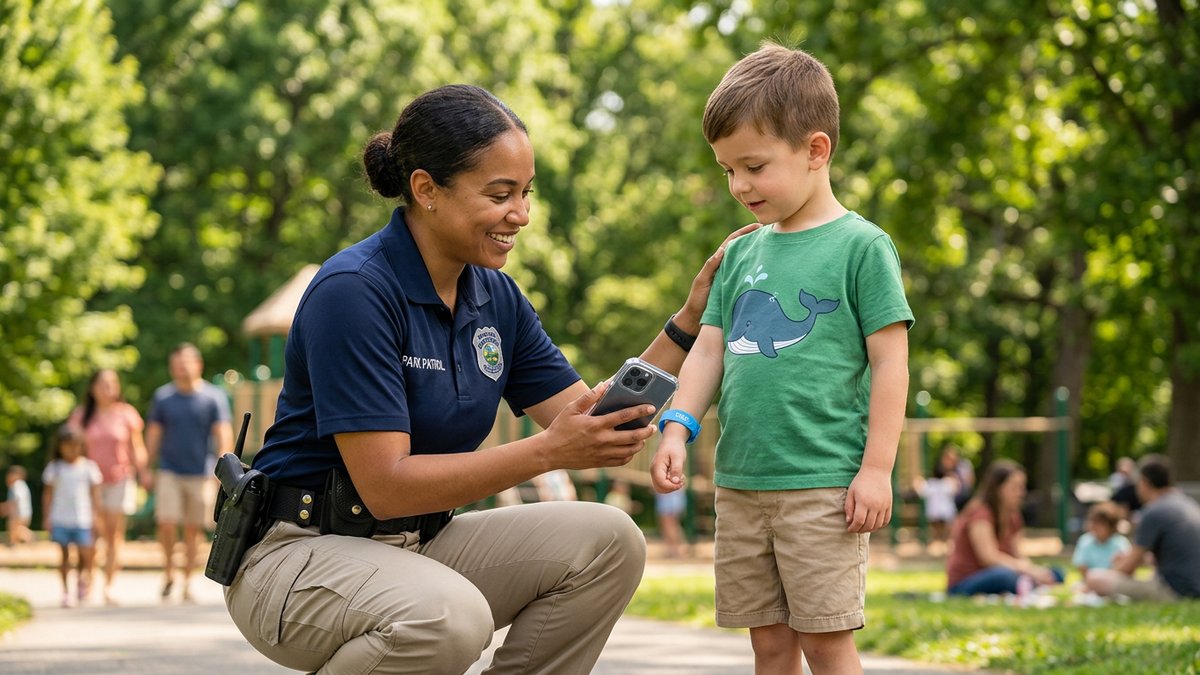
Near-field communication (NFC) technology powers the tap-to-pay feature on most modern smartphones. The same technology can be embedded in a child's wristband, allowing any smartphone user to tap the wristband and instantly access emergency contact and medical information - no app download, no account required, no battery needed.
The key insight is that NFC wristbands solve a different problem than GPS trackers. GPS answers the question "where is my child?" NFC answers the question "who is this child and how do I help them?" In crowded public spaces, it is the second question that gets answered first - by the stranger, security guard, or park employee who finds a scared child and needs to know what to do.
Building a Grandparent-Ready Safety System: A Practical Framework
The most effective child safety systems are layered. No single tool covers every scenario. Here is a framework that works specifically for families where grandparents are regular caregivers.
Layer 1: Identity Information That Lives on the Child
A child should always carry some form of identification that can be accessed by a stranger or first responder without requiring the grandparent to be present and functional in a crisis. For children under ten, this means a physical or digital ID that stays on the child's body.
The best options for this layer:
- NFC wristband with current emergency contacts and any relevant medical notes
- A written card in the child's bag or pocket with name, parent contact, and caregiver contact
- For children with medical conditions: a medical ID bracelet or tag that specifies the condition
The NFC wristband is the most practical for active children because it is waterproof, cannot fall out of a pocket, does not require the child to do anything, and can be updated remotely when emergency contacts change.
Layer 2: What the Grandparent Needs to Have Ready
Before any outing with grandchildren, grandparents should have access to three things:
A current photo. Most grandparents have recent photos of their grandchildren, but the photo should be on the phone they carry, not in an album at home. Security staff at venues ask for photos immediately when a child is reported missing.
The child's full name and date of birth. This seems obvious, but grandparents often know their grandchildren's nicknames better than their legal names. If reporting a missing child to park security, "my grandson Tommy" is less useful than "Thomas James Reyes, age five, born March 2021."
A single emergency contact number for the parent. Not stored in a cluttered contacts list under an ambiguous name. One number, clearly labeled, easy to access quickly.
Layer 3: Venue and Context Preparation
Before entering any crowded venue, take three minutes to complete what safety experts call a "point of separation" plan:
- Identify the meeting point where everyone will go if separated (not "the entrance" - a specific, distinctive landmark)
- Show the child what security staff or park employees look like so they know who to approach
- Review what the child should say: their name, that they are with their grandmother or grandfather, and that they need help finding their family
- Confirm the wristband is on and the profile information is current
This conversation does not need to be frightening. Frame it the same way you would a fire drill - it is something you practice so that if it ever happens, everyone already knows what to do.
Layer 4: Medical Information Accessibility
For children with allergies, asthma, autism, epilepsy, diabetes, or any other condition that could become relevant in an emergency, the grandparent caregiver should have specific information prepared:
- The condition name and a one-sentence explanation of what it means in practical terms
- Any medications the child takes, including dosage and timing
- What an emergency related to the condition looks like and what first aid steps are appropriate
- The child's pediatrician's contact information
This information should also be accessible to first responders independently of the grandparent. Medical details stored in an NFC wristband profile can be accessed by paramedics even if the grandparent is not present or is incapacitated.
Talking to Grandparents About Child Safety Technology: A Parent's Guide
This section is specifically for parents who want to have a productive conversation with their own parents about child safety tools without creating conflict or implying distrust.
The framing matters enormously. "Mom, I got this wristband because I don't trust you to keep track of him" is a conversation that ends badly. "Mom, I set this up so that if he ever wanders off at the fair, any stranger nearby can immediately call me - it protects you as much as it protects him" is a completely different conversation.
Emphasize what the grandparent does not need to do. With a properly set-up NFC wristband, the grandparent's only responsibility is making sure the child wears it. The parent sets up the profile. The parent updates the contacts. The parent manages the technology. The grandparent benefits from the protection it provides without carrying any technical burden.
Some grandparents will push back on the idea of technology-assisted safety because it can feel like a suggestion that they are not competent caregivers. Acknowledge their competence directly. The goal is not to monitor the grandparent - it is to make the child identifiable to strangers and first responders in the rare event that something goes wrong despite everyone doing everything right.
The Digital Safety Conversation: Screen Time and Online Safety at Grandma's House
Physical safety is the highest-stakes concern, but digital safety is increasingly relevant for grandparents providing home-based childcare. Children as young as three are using tablets, and by age seven, most children in the United States are using the internet regularly.
For grandparents managing screen time, a few practical principles apply:
Supervised viewing, not just filtered viewing. Parental controls and content filters are useful, but they are not perfect. Sitting with a young grandchild during tablet or TV time is the most reliable form of digital safety for young children.
Default to physical activity. Screen time tends to expand to fill available time. If grandparents plan activities - a walk, a craft project, a board game, baking - screens become a smaller part of the visit naturally.
Ask the parents what the rules are. Screen time limits, approved apps, and content standards vary widely between families. Grandparents who ask directly and follow the parent-set guidelines create continuity that is good for the child and good for the family relationship.
Understand the platforms your grandchildren use. You do not need to be a social media expert, but knowing what YouTube Kids is, understanding that video games can have chat functions, and knowing what apps are on a grandchild's device helps you have meaningful conversations and notice when something seems off.

When to Call 911 vs. Venue Security vs. the Parent: A Quick Decision Framework
One area where grandparents and parents sometimes disagree is around escalation - when an incident becomes serious enough to call emergency services versus handling it at the venue level.
Call 911 immediately if:
- The child has a medical emergency (allergic reaction, seizure, injury requiring immediate care)
- You have reason to believe the child was taken rather than wandered
- The child has been missing for more than fifteen minutes in a large public space
Contact venue security or staff immediately if:
- You cannot locate the child after a few minutes of searching
- You are in a large venue with a dedicated security or lost child program
- The child is found by someone else and you need to coordinate reunion
Contact the parent immediately if:
- Any safety incident occurs, even minor ones that resolve quickly
- You are unsure how to handle a situation involving the child's medical needs
- The child is distressed and asking for their parent
Parents often wish they had been called sooner rather than later. Even if an incident resolves happily, most parents want to know it happened.
Creating a Simple Emergency Card for Grandparent Caregivers
For parents who want a tangible, non-tech backup that grandparents can carry, a simple emergency card is worth creating. Here is what it should include:
- Child's full legal name and date of birth
- Parent's cell phone number (primary) and work number if applicable
- A second emergency contact (other parent, aunt, uncle, trusted neighbor)
- The child's pediatrician name and number
- Medical conditions, allergies, and current medications (with dosages)
- A current photo of the child
This card should be laminated or placed in a protective sleeve and kept in the grandparent's wallet alongside their own ID. Update it annually or whenever information changes.
A physical card combined with an NFC wristband creates a genuinely resilient system. The card serves the grandparent. The wristband serves everyone else.
The Safety Tech Checklist for Grandparents and Parents
Before handing off childcare responsibilities, work through this checklist together:
For every outing:
- Child is wearing identification (NFC wristband or ID bracelet)
- Grandparent has a current photo on their phone
- Grandparent has parent's cell number easily accessible
- Meeting point has been discussed with the child if the destination is a large venue
- Child knows their full name and what to say if they get lost
For home-based care:
- Emergency contacts are posted near the front door and in the kitchen
- Grandparent knows the child's pediatrician name and number
- Medications are clearly labeled with dosage instructions
- Grandparent has been briefed on any relevant medical conditions
- Screen time rules have been communicated and agreed upon
For overnight or extended care:
- Written medical information is available including medication schedule
- School or activity schedules and contact information are shared
- Insurance cards are accessible or copies are provided
- Grandparent knows the family's preferred hospital or urgent care
What Grandparents Do Better Than Any App
It is worth saying directly: grandparents are not a technology gap to be patched. The qualities that make grandparents exceptional caregivers - patience, attentiveness, a deep emotional investment in the child's wellbeing, life experience that has taught them to stay calm under pressure - are not replicable by any app or device.
The role of technology in grandparent caregiving is not to compensate for anything. It is to handle the specific, narrow problem of "what happens if, despite everyone doing everything right, a child and grandparent are separated in a crowd?" or "what happens if a grandparent cannot immediately communicate a child's medical information to a first responder?"
Technology fills those specific gaps. Everything else - the judgment, the care, the attentiveness, the relationship with the grandchild - belongs entirely to the grandparent.
The goal is a system where parents feel confident handing off to grandparents, grandparents feel equipped and not burdened, and children move through the world with the full protection of both generations working together.

TapTap Buddy Team
Our team of child safety experts, parents, and technology specialists is dedicated to creating innovative solutions that keep children safe. With backgrounds in emergency response, pediatric care, and smart technology, we bring real-world experience to every article.
View all articles