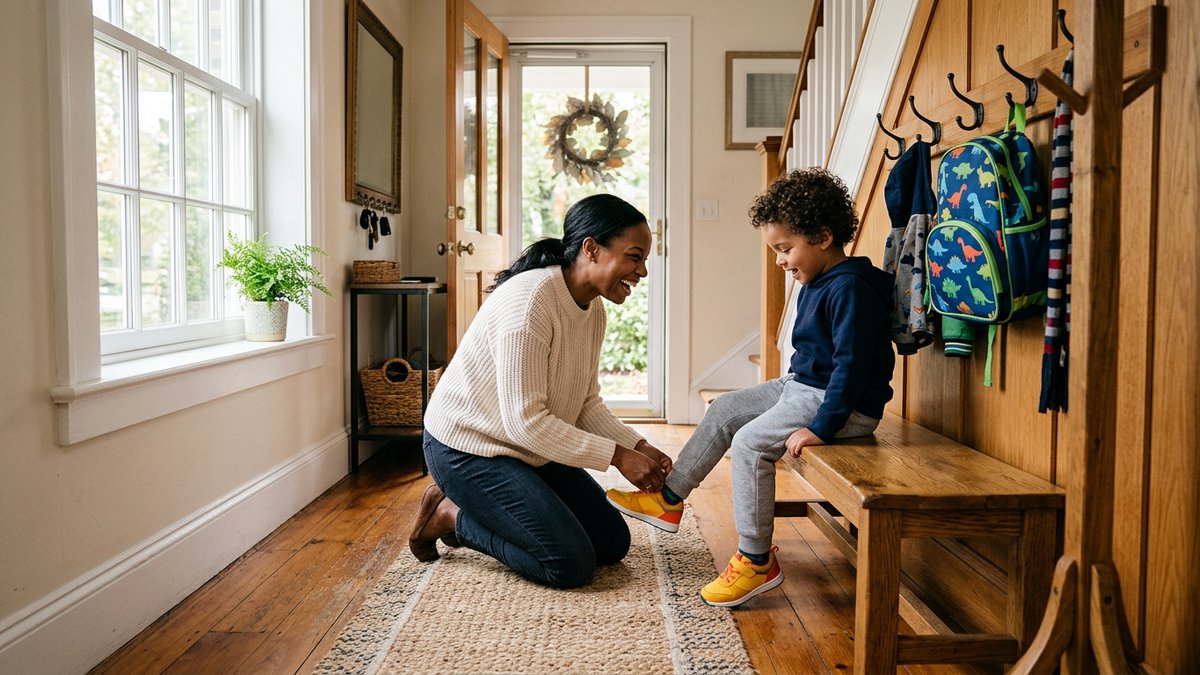
Building Independence: Safety Nets for Growing Kids
Independence is a skill children build through practice - but 44% of parents cite safety concerns as the top barrier to letting kids try. This guide breaks down age-by-age independence milestones, the three things every safety net needs, and a practical readiness checklist to help parents say yes with confidence.

Quick Answer
Children build independence through graduated practice, not a single leap. Start with small solo steps at whatever age your child is now, do a dry run together, establish a check-in plan, and make sure emergency contact information is wearable and accessible to any adult. The safety net enables more independence - it does not replace it.
Growing up means gradually doing more on your own. But for today's parents, "letting go" often feels less like a milestone and more like a high-stakes gamble. Research from the C.S. Mott Children's Hospital National Poll on Children's Health found that 44% of parents name safety as the number one barrier to independence for children aged 5 to 8 - even as child injury death rates have fallen from 6 to 2 per 10,000 over the last five decades.
The data paints a striking picture: parents want their kids to be independent, yet anxiety consistently outpaces actual risk. The good news is that independence and safety are not opposites. With the right tools and mindset, a safety net makes it possible to say "yes" far more often.
Why Independence Is a Skill, Not a Risk
Most people think of independence as something kids either have or lack. In reality it is a learned capability built up through hundreds of small, successful solo experiences. Child development researchers describe this as "graduated autonomy" - widening the circle of freedom in manageable increments so children can practice decision-making, manage small problems, and develop genuine self-confidence.
The Mott Poll data reveals a troubling gap between what parents believe and what they allow. A full 74% of parents say they actively promote independence in their children. Yet when researchers looked at concrete behaviors, only 20% allow their child to prepare their own snacks, and just 33% permit walking to a friend's house. Even more telling: 54% of parents worry that someone will frighten or threaten their child during unsupervised time - but only 17% actually consider their neighborhood unsafe. That is a 37-point anxiety gap between perceived threat and measurable reality.
The cost of over-protection is real. Children who are shielded from manageable challenges have fewer opportunities to develop problem-solving skills, frustration tolerance, and what psychologists call "self-efficacy" - the belief that you can handle what life throws at you. Harvard Health research confirms that children who practice independence in low-stakes situations are better equipped to handle high-stakes ones later.
Independence, in other words, is not a risk. It is a protective factor. The goal is not to remove the safety net but to make it invisible enough that kids stop noticing it - and start trusting themselves.
The Age-by-Age Independence Ladder
There is no universal timetable for independence, but developmental research offers useful benchmarks. Every child is different, and these ranges are starting points rather than rigid standards. The Child Development Institute notes that temperament, prior experience, and neighborhood context all influence readiness.
Ages 4 to 6: Foundations
Children at this stage are building basic competencies: dressing themselves, remembering simple rules, understanding what to do if they feel lost or scared. Key milestones to work toward include:
- Walking to the mailbox or front yard alone
- Playing in a fenced backyard without direct supervision
- Knowing their full name, their parent's first name, and a phone number
- Understanding when and how to ask an adult for help
Safety focus at this stage is less about physical range and more about information. Can your child communicate who they are? Do they know what a "safe adult" looks like in a public setting?
Ages 6 to 8: Expanding the Circle
This is the age when many kids are ready to walk short distances, spend time at a neighbor's house, and navigate a grocery store aisle while a parent is two rows over. The Mott Poll identifies this range as particularly underserved - parents apply more restriction here than developmental research recommends.
Milestones to work toward:
- Walking one or two blocks to a friend's house
- Spending 30-60 minutes at home alone during daylight
- Ordering their own meal at a restaurant
- Handling a small problem (scraped knee, lost jacket) without immediate parental intervention
Safety focus shifts to communication and judgment. Can your child identify when a situation feels wrong? Do they know how to reach you, or another trusted adult?
Ages 8 to 10: Real Independence
The 8-12 age range is where developmental readiness and parental anxiety collide most sharply. Research from the Child Development Institute shows children in this range are cognitively ready for significantly more autonomy than most parents extend. This is also when the gap between restriction and readiness has the greatest downstream impact on adolescent confidence.
Milestones to work toward:
- Biking or walking to school independently
- Spending several hours home alone
- Managing a simple errand (library return, corner store run)
- Using public transit with a friend
Safety focus becomes about judgment, communication protocols, and backup systems. What is the plan if something unexpected happens?
Ages 10 and Up: Autonomy With Accountability
Older kids and pre-teens are ready to navigate their community, manage their schedule, and handle minor emergencies. The parental role shifts from supervisor to consultant. Independence at this stage is the foundation for the self-management skills they will need in high school, college, and beyond.
Safety focus is about having robust backup systems in place so that genuinely rare emergencies - a fall, a medical event, a confusing situation - can be handled even when you are not there.

What Every Safety Net Needs
A safety net is only useful if it actually works when tested. Parents often build mental safety nets ("I'll be nearby") or digital ones (tracking apps that require a charged phone and a working data connection). These fail quietly and at the worst moments. A reliable safety net for an independently operating child has three components.
Emergency Contact Information, Always Accessible
Children's memory becomes unreliable under stress. Research on stress and cognition from the American Psychological Association shows that the prefrontal cortex - responsible for recall and decision-making - is partially offline during acute anxiety. A child who can perfectly recite your phone number at the breakfast table may go completely blank when they are lost, hurt, or frightened.
The solution is not more memorization. It is making critical information accessible without requiring retrieval from memory. A physical record on the child - not buried in a bag pocket, not on a phone that could be dead - solves this problem reliably.
A Way for Any Adult to Help
The safety net breaks down if the information is accessible only to certain people with the right app or the right device. A child in distress may encounter any adult: a neighbor, a store clerk, a school administrator, a stranger on the street. The system needs to work for all of them.
This is why app-dependent solutions have a meaningful gap. If the adult who finds your child does not have a specific app installed, the information is functionally invisible. A universal access mechanism - one that works on any smartphone, with no app required - is significantly more reliable.
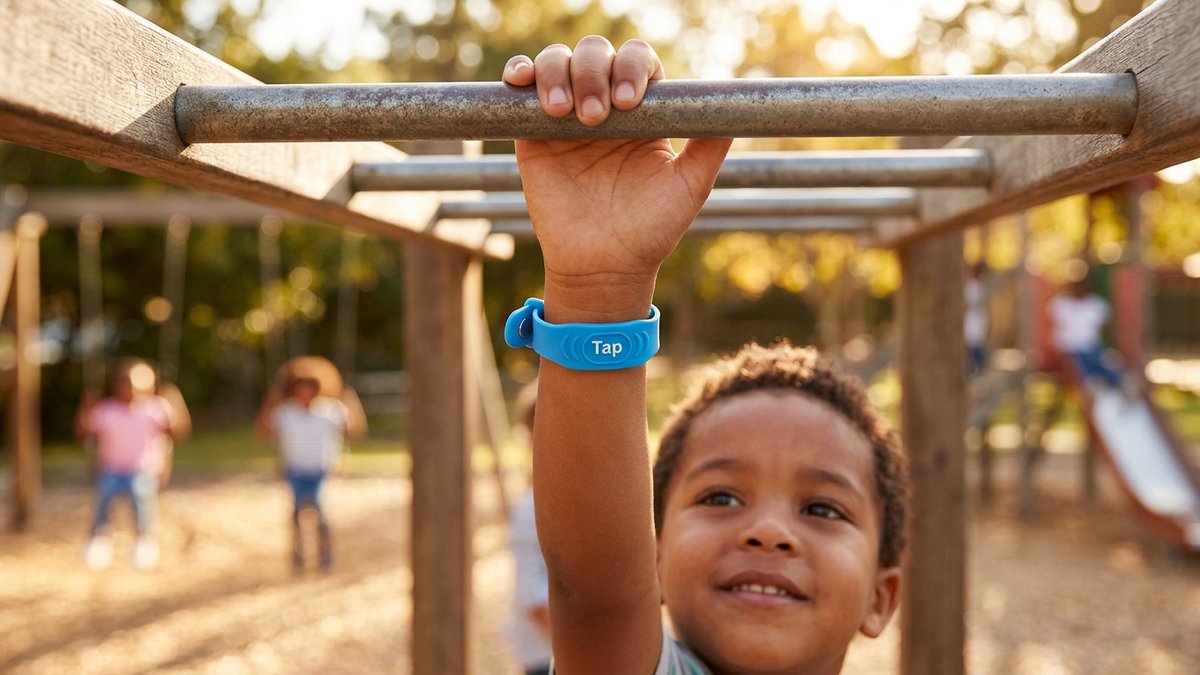
Wearable, Not Carry-able
Kids lose things. Jackets get left at school. Backpacks get set down. Wallets and cards go missing. Wearable identification solves the "left behind" problem because it is attached to the child, not their belongings.
Building Confidence One Step at a Time
Knowing what milestones exist is one thing. Helping a child actually get there is another. The most effective approach combines three elements: graduated exposure, preparation rituals, and deliberate debriefs.
Graduated Exposure
Start smaller than you think necessary. If the goal is walking to a friend's house three blocks away, begin by walking the route together, then walking it while staying one block behind, then watching from the front door. Each successful solo step becomes evidence the child can use internally: "I did it before, I can do it again."
Research from the CDC on child development supports breaking new challenges into sub-steps. The brain consolidates competence through repetition in low-stakes conditions, not one-off leaps.
Dry Runs
Before a child does something independently for the first time, do a dry run together. Walk the route and name the landmarks. Identify the "safe stop" locations: the library, the fire station, the neighbor three houses down who knows you. Practice what to say if they need help. Rehearsal dramatically reduces the cognitive load in the actual moment.
For younger children, make it a game: "What would you do if you fell off your bike?" Running the scenario out loud, in a comfortable setting, builds the mental script they will reach for under pressure.
The Debrief Ritual
After every independent excursion, spend five minutes debriefing. Not interrogating - debriefing. What went well? Was anything surprising? What would they do differently? This conversation does two things: it communicates that you trust them enough to debrief like a capable person, and it builds the narrative of competence they carry into the next challenge.
Tinybeans research on family confidence-building found that children who have regular reflective conversations with parents about their independent activities develop higher self-reported confidence scores by age ten. The debrief is not overhead - it is the learning.
Common Parent Fears and What the Data Says
"What About Strangers?"
The stranger danger framework, popularized in the 1970s and 1980s, has been substantially revised by researchers and child safety advocates. The National Center for Missing and Exploited Children consistently reports that children are far more at risk from known adults than strangers. Most genuine safety risks for children in the 6-12 range involve accidents and injuries, not stranger abduction.
This does not mean stranger awareness is useless. It means the framing matters. Teaching children to identify unsafe situations and seek help from trustworthy public figures (librarians, store clerks, uniformed personnel) is more practically useful than teaching blanket fear of anyone unfamiliar.
"What If They Get Hurt?"
Some degree of physical risk is inseparable from childhood. The question is not how to eliminate injury risk - it is how to make sure that when minor injuries happen, the child has the skills and resources to handle them. A scraped knee managed without a parent present is a competency milestone. The experience of handling a small injury independently builds the capacity to handle larger challenges with equanimity.
For genuine medical emergencies, the preparation question is: does any adult who might encounter your child have an instant way to know who to call and what health information matters? That is the gap a wearable emergency profile closes.
"What If They Make a Bad Decision?"
Children make bad decisions. This is not a parenting failure - it is a developmental feature. Decision-making capacity is built through practice, including the practice of making choices that do not work out. A child who has never been allowed to make small bad decisions and experience manageable consequences has significantly less decision-making bandwidth when the stakes are higher.
The appropriate response to a bad decision is a calm debrief, not tighter restriction. The goal is a child who develops better judgment over time, not one who is perpetually protected from the opportunity to exercise any.

The Independence Readiness Checklist
Before extending a new level of independence, run through this checklist together with your child. It is not a test - it is a shared preparation ritual that helps both parent and child feel genuinely ready.
Information the child can communicate:
- [ ] Full name and home address
- [ ] Parent's full name and mobile number (from memory or on wristband)
- [ ] Name of a backup adult and how to reach them
- [ ] Any relevant medical information (allergies, conditions)
Skills the child has practiced:
- [ ] Has walked or ridden the route at least once with a parent
- [ ] Knows the "safe stops" along the way
- [ ] Can ask a public figure (librarian, store worker) for help
- [ ] Knows what to do if they feel unsafe (trust the gut, find a safe adult, call home)
Systems in place:
- [ ] Check-in plan is established (call when you arrive, text when leaving)
- [ ] Parent knows the route and expected timeline
- [ ] Child has a way to make a phone call if needed
- [ ] Emergency contact information is wearable and accessible, not just memorized
Parent readiness:
- [ ] You have done the dry run together
- [ ] You have discussed the "what if" scenarios out loud
- [ ] You are prepared to let it go and let them do it
When the checklist is complete, the answer is yes. Not "maybe" and not "we'll see." A clear yes, extended with confidence, does more for a child's development than a reluctant, anxious permission that communicates "I don't really trust you."
Independence is not something that happens to children. It is something parents actively build, one small yes at a time.

TapTap Buddy Team
Our team of child safety experts, parents, and technology specialists is dedicated to creating innovative solutions that keep children safe. With backgrounds in emergency response, pediatric care, and smart technology, we bring real-world experience to every article.
View all articles