Non-Verbal Child Safety: Communication Tools for Emergencies
Nearly 1 in 3 children with autism who elope cannot tell a stranger their name or who to call. This guide covers every communication and identification tool available to parents of non-verbal children, from AAC therapy systems to NFC wristbands, with a focus on what works when words are not an option.

Quick Answer
For non-verbal children, safety in emergencies depends on passive identification tools that work without the child's participation. An NFC wristband displays a child's name, photo, emergency contacts, and medical information to any smartphone with a single tap - no battery, no signal, no app required. Pair this with door alarms, first responder pre-registration, and an AAC emergency vocabulary set for a layered approach.
Every 20 minutes, a child with autism spectrum disorder goes missing in the United States. According to the National Autism Association, nearly half of all children with ASD will elope - wander away from safe environments - at least once before their 18th birthday. Of those who elope, roughly one in three cannot communicate their own name, their address, or a parent's phone number to a stranger. For the families of the estimated 800,000 minimally verbal or non-verbal children with autism in the United States, this is not an abstract statistic. It is a daily reality that shapes every outing, every transition, and every moment of letting go.
The communication challenges that come with autism, childhood apraxia of speech, cerebral palsy, Down syndrome, and other conditions are well-documented. Research from the National Institute on Deafness and Other Communication Disorders (NIDCD) estimates that 25 to 30 percent of children with ASD are minimally verbal, meaning they produce fewer than 30 meaningful words in daily life. For these children, the standard emergency response assumptions - that a child will tell a rescuer who they are, where they live, and who to call - simply do not apply.
The gap in the existing conversation about child safety is striking. Hundreds of articles cover GPS trackers and location monitoring. AAC therapy resources are abundant in clinical and educational settings. But almost nothing connects those two worlds: the daily reality of raising a non-verbal child with the practical emergency safety tools that could protect them when words are not available. Parents navigating this space are often left piecing together advice from autism forums, therapy waiting rooms, and worst-case-scenario news stories.
This article addresses that gap directly. It covers the landscape of communication and identification tools for non-verbal and minimally verbal children, from long-established AAC therapies to newer digital identification technologies, with a focus on what parents can do right now to make their child safer in emergencies. The goal is practical: a working knowledge of what is available, when each tool matters, and how to layer multiple approaches into a safety plan that does not depend on words.
Understanding the Scope: Why Non-Verbal Children Face Unique Safety Risks
The safety risk for non-verbal children is not hypothetical or rare. According to the National Autism Association, wandering and elopement is the leading cause of death for individuals with autism. Drowning accounts for 71 percent of fatal wandering incidents among children with ASD, and research suggests these children are approximately 160 times more likely to drown than their neurotypical peers.
The reasons are interconnected. Many children with ASD are drawn to water - a phenomenon sometimes called a "fatal attraction" by researchers. When they elope, they often move quickly and purposefully toward water sources without the fear response or self-protective awareness that many neurotypical children develop. And if a first responder or community member finds a non-verbal child near a body of water, they have no way of knowing the child has autism, no way to contact a parent, and no way to understand why the child is not responding to verbal questions.
Who Is Most Affected
Non-verbal and minimally verbal children represent a broader group than autism alone. According to data from the CDC, approximately 1 in 31 U.S. children is diagnosed with ASD as of the most recent surveillance estimates - a figure that has increased significantly over the past two decades. Within that group, studies suggest 25 to 30 percent are minimally verbal.
Beyond autism, other diagnoses commonly associated with significantly limited verbal communication include:
- Childhood apraxia of speech (CAS), a motor speech disorder affecting coordination of speech movements
- Cerebral palsy with associated speech impairment, affecting approximately 25 to 40 percent of individuals with CP
- Down syndrome, where speech development is frequently delayed and sometimes significantly limited
- Landau-Kleffner syndrome and other acquired epileptic aphasias
- Severe intellectual disability across various underlying diagnoses
For all of these populations, the emergency identification problem is the same: if a child cannot speak, a stranger cannot help them the way they would help a child who can say "my name is Sophie and my mom's number is..."
The Wandering and Elopement Reality
Research published in Pediatrics found that 49 percent of children with ASD had attempted to elope at least once after age four. Among those children, 24 percent went missing long enough to cause significant concern for safety. Nearly one-third could not communicate their name and address to a rescuer.
The National Autism Association notes that 91 percent of autism-related deaths occur due to accidental injury, with drowning being the most common cause. The intersection of limited verbal communication, fast movement, and attraction to hazards creates a safety profile unlike almost any other pediatric population.
The Landscape of Communication Tools: AAC and Beyond
Augmentative and alternative communication (AAC) refers to the full range of methods people use to communicate beyond natural speech. For children with limited or absent verbal language, AAC is not a replacement for speech therapy - it is a bridge that supports communication development while also providing a functional communication system right now.
According to the American Speech-Language-Hearing Association (ASHA), research consistently shows that AAC does not inhibit speech development and may actually support it by providing a reliable communication system that reduces frustration and opens opportunities for interaction.
Unaided AAC: Sign Language and Gestures
Unaided AAC relies entirely on the communicator's body, with no external tools required. The most common unaided systems include:
- American Sign Language (ASL) or signed English systems, which use standardized hand shapes and movements
- Key Word Sign approaches, where a smaller vocabulary of functional signs is taught alongside speech
- Gestural communication systems developed informally within a family or therapy context
The significant limitation of unaided AAC in emergencies is obvious: if a child begins signing to a first responder who does not know ASL, communication has not actually occurred. Unaided systems are powerful within a child's established communication community - family, teachers, therapists - but their utility with strangers in emergency situations is limited.
Aided Low-Tech AAC: Picture Boards and Communication Books
Low-tech aided AAC includes any communication system that uses a physical tool but does not require electronics or batteries. Common formats include:
- PECS (Picture Exchange Communication System), a structured approach where children exchange picture cards to make requests and comments
- Communication boards and books, collections of symbols, photographs, or drawings organized for quick access
- Core vocabulary boards, which display high-frequency words across multiple categories, allowing more flexible communication
- Topic-specific boards, designed for particular environments or activities such as medical appointments, the grocery store, or the playground
Low-tech AAC is durable, affordable, and does not require a charge. Many families create emergency-specific communication boards that include a child's name, photo, emergency contacts, medical information, and key phrases such as "I am lost" or "I have autism." These can be laminated and attached to a backpack, stored in a caregiver bag, or sewn into clothing.
The challenge is that low-tech tools require the child to have them in hand and know how to use them in a stressful situation, and require a stranger to recognize what the tool is and how to interpret it.
High-Tech AAC: Speech Generating Devices and Apps
High-tech AAC includes electronic devices that produce speech output, ranging from dedicated speech generating devices (SGDs) to tablet-based applications. Commonly used systems include:
- Proloquo2Go and Snap Core First for iOS and Android
- LAMP Words for Life, based on Language Acquisition through Motor Planning principles
- TouchChat and Cough Drop, flexible symbol-based communication apps
- Dedicated SGDs from manufacturers such as PRC-Saltillo and Tobii Dynavox
High-tech AAC devices can give a child a functional voice in real time. A child who knows their device can navigate to a "help" or "emergency" vocabulary set and play a message that communicates their needs to a stranger. Some families program specific emergency messages directly into the device's home screen.
However, high-tech devices have real limitations in emergency contexts:
- Batteries may be depleted, especially if the device was used heavily before the emergency
- The device may not be with the child at the moment of wandering
- A child in a state of distress or sensory overload may not be able to operate the device
- Strangers may not understand how to interact with an AAC device or may not wait long enough for the child to navigate to a message
Research suggests that AAC is most effective as an ongoing communication system but should be paired with passive identification methods that do not require the child's active participation in an emergency.
Medical Alert and Identification Tools for Non-Verbal Children
Beyond AAC systems designed for day-to-day communication, a distinct category of tools exists specifically for emergency identification. These tools do not require the child's participation - they work passively, providing information to anyone who encounters the child.
Traditional Medical Alert Jewelry
Medical alert bracelets and necklaces have existed for decades, primarily for conditions such as diabetes, severe allergies, and epilepsy. Organizations including the Epilepsy Foundation recommend that individuals with seizure disorders wear medical ID at all times, noting that it enables first responders to provide appropriate care quickly.
For non-verbal children with autism or other disabilities, engraved medical ID jewelry can include:
- The child's first name
- Primary diagnosis (such as "autism" or "non-verbal")
- An emergency contact phone number
- Critical medical information (allergies, medications, conditions affecting emergency care)
The limitation is space. A standard medical ID bracelet holds perhaps 40 to 60 characters - enough for a name, one condition, and one phone number. It cannot communicate behavioral guidance, sensory sensitivities, communication strategies, or secondary emergency contacts. And a standard-issue metal bracelet may not be well-tolerated by children with sensory sensitivities, which is common in the ASD population.
Autism Awareness and Safety Patches
Specialty vendors offer iron-on or velcro patches for clothing, backpacks, and harnesses that identify a child as having autism and may include a QR code or phone number. These are low-cost, low-profile, and can be placed on items the child typically wears.
The challenge with patches is durability and placement consistency. If the patch is on a specific jacket the child is not wearing when they elope, it provides no protection. Patches are also subject to wear and may become unreadable over time.
Digital ID Cards and Information Cards
A number of organizations produce paper or laminated cards designed for non-verbal individuals or individuals with autism that explain how to communicate with the person and include emergency contact information. Some families customize their own versions.
These cards are most useful when kept on the child's person - in a pocket, clipped to a belt loop, or attached to a backpack. Like low-tech AAC, they require either the child or a bystander to locate and read the card, which may not happen automatically in a fast-moving emergency situation.
NFC Technology: Passive Digital Identification for Non-Verbal Children
Near field communication (NFC) technology represents a newer approach to the emergency identification problem. Unlike traditional ID tools, NFC-enabled wristbands and tags can store and transmit a comprehensive digital profile that any NFC-capable smartphone can read with a simple tap - no app download required, no internet connection needed, no battery required on the wristband itself.
For non-verbal children, the value of NFC identification is precisely its passivity. The child does not need to do anything. The tool does not depend on the child's ability to communicate under stress, access a device, or navigate an app. When a first responder, parent, teacher, or concerned community member finds a child, a single tap on the wristband surfaces everything they need: the child's name, photo, emergency contacts, medical information, communication guidance, and behavioral strategies.
What NFC Identification Can Communicate
A well-configured NFC wristband profile can include information that traditional medical ID simply cannot fit. For a non-verbal child with autism, this might include:
- Full name, preferred name, and a photograph
- Primary diagnosis and relevant communication information (for example, "Maya is non-verbal. She communicates using gestures and may become distressed if spoken to loudly.")
- Up to four emergency contacts with names, relationships, and phone numbers
- Critical medical information including allergies, medications, and conditions
- Behavioral guidance for strangers ("Maya may resist physical touch. Staying calm and using a quiet voice will help her feel safe.")
- Sensory information that can guide a first responder's approach
- A link to a more complete digital profile accessible online
This depth of information is simply not achievable with engraved metal. And unlike a paper card, a digital profile can be updated instantly by the parent if phone numbers change, medications change, or new guidance becomes relevant.
How NFC Works in a Real Emergency
Consider a realistic scenario. A seven-year-old non-verbal child with autism elopes from a backyard while a caregiver's attention is briefly elsewhere. Within minutes, a neighbor finds the child two streets over, standing at the edge of a drainage ditch. The child does not respond to questions, does not make eye contact, and shows no signs of communicating verbally.
Without any identification, the neighbor calls 911. Police arrive, attempt to communicate, and the child becomes increasingly distressed. Finding a parent may take 30 to 90 minutes, during which the child remains in an escalating state of distress.
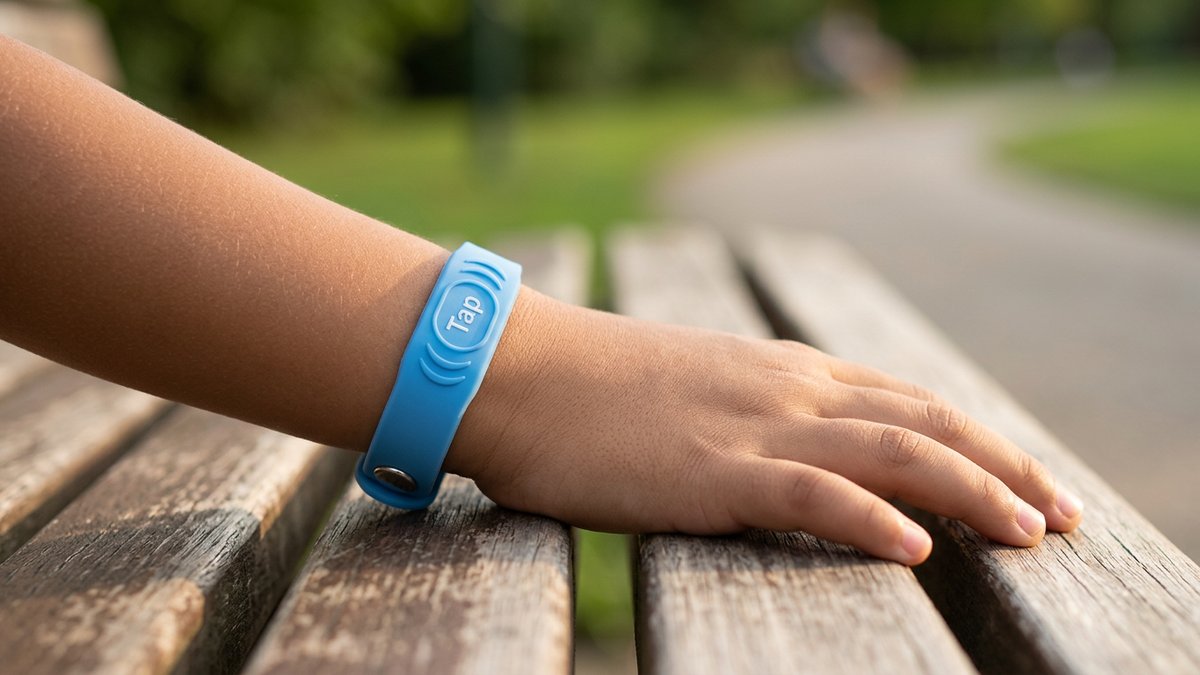
With an NFC wristband, the neighbor's instinct is to look at the wristband, notices it says "Tap," and taps it with their phone. Within seconds, they see the child's name, photo, confirmation that the child has autism and is non-verbal, and three emergency contact numbers. They call the parent directly. The child is home in under ten minutes.
Tolerability and Sensory Considerations
Any wearable identification tool for a child with autism must address sensory tolerance. Many children with ASD have significant tactile sensitivities, and a wristband they will not wear provides no protection at all.
Quality NFC wristbands designed for children are typically made from soft medical-grade silicone, which tends to be better tolerated than metal or hard plastic. The absence of buttons, screens, charging cables, or any electronics on the exterior of the wristband means there are no sensory-irritating elements beyond the band itself.
Families report that introducing the wristband gradually, pairing it with positive associations, and involving the child in choosing a color or design significantly improves long-term compliance. Some families treat the wristband the way they treat shoes: it is simply something that goes on before leaving the house, every time.
Building a Layered Emergency Safety Plan
No single tool is sufficient. Research on child safety and elopement consistently supports a layered approach that combines environmental, behavioral, and technological strategies. According to the National Autism Association's Big Red Safety Toolkit, a comprehensive approach to wandering prevention and response should address four areas:
Layer 1: Environmental Modifications
Environmental barriers are the first line of defense. These include:
- Door alarms that alert caregivers when exterior doors are opened
- Pool fencing and self-latching gate mechanisms (particularly important given the drowning risk data)
- Window guards and window alarms
- Locks positioned above a child's reach or requiring two-step operation
- Wearable alert systems that notify caregivers when a child leaves a defined area
The National Autism Association recommends that families contact local police, fire, and emergency services to register their child with autism and provide a photo, physical description, and information about the child's communication needs and any behavioral characteristics relevant to a search.
Layer 2: Communication and Social Safety Skills
Many children with autism can learn specific emergency communication skills, even if they are minimally verbal. These skills are best taught in partnership with an ABA therapist or speech-language pathologist and may include:
- Recognizing and approaching trusted adults such as police officers, firefighters, or store employees
- Responding to their name being called
- Using a communication device to access emergency vocabulary
- Accepting assistance from a stranger in a calm, non-threatening environment
Research suggests that systematic, repeated practice in naturalistic settings improves generalization - meaning the child is more likely to use these skills when it actually matters.
Layer 3: Identification Technology
This is where the tools described throughout this article come into play. A layered identification strategy for a non-verbal child might include:
- An NFC wristband worn daily with a comprehensive digital profile
- An engraved medical ID bracelet or tag as a backup
- An autism safety card or laminated information card in their backpack
- An identification tag sewn into the waistband of clothing (a failsafe if all other items are removed)
The redundancy matters. Each layer covers scenarios where others might fail.

Layer 4: Community Awareness and Emergency Preparedness
The final layer involves the people and systems around the family:
- Notify neighbors, regular community members, and nearby businesses that the child may wander and what to do if found
- Register with local emergency services and provide an updated photo and relevant information annually
- Create a written wandering response plan that family members, babysitters, and teachers all know
- Practice the response plan periodically so it is not executed for the first time in a real emergency
The Autism Speaks wandering safety resource center offers free toolkits and guidance on community notification strategies, first responder education, and family action planning.
Talking to Your Child's Care Team About Safety Planning
Safety planning for a non-verbal child is not something families should navigate alone. The most effective plans are developed collaboratively across a child's entire support network.
Speech-Language Pathologists and AAC Teams
An SLP specializing in AAC can assess a child's current communication abilities and recommend the most appropriate AAC system for both daily communication and emergency situations. They can also program emergency vocabulary into existing AAC devices and help design emergency-specific communication boards tailored to the child's symbol recognition and motor abilities.
Behavioral Analysts and Therapists
Applied behavior analysis (ABA) therapists can design systematic teaching programs to build specific safety skills, including wandering prevention behaviors and emergency communication responses. They can also help develop strategies to increase a child's tolerance for wearing safety identification tools.
Pediatricians and Developmental Specialists
A child's physician can document specific medical information that belongs in a digital ID profile, communicate with first responders on behalf of the family when relevant, and connect families with community resources including first responder autism training programs.
School IEP Teams
For school-age children with disabilities, the Individualized Education Program (IEP) process is an appropriate venue for addressing safety planning. An IEP can include specific goals related to wandering prevention, emergency communication skills, and the use of assistive technology. Transportation safety, field trip protocols, and emergency drill accommodations should all be addressed within the IEP framework.
What To Do Right Now: An Action Checklist for Parents
If you have a non-verbal or minimally verbal child and are concerned about emergency identification and safety, this checklist provides a starting framework:
This week:
- Take a current photograph of your child in their usual clothing, from multiple angles, including their height
- Write down all emergency contacts, medical information, and behavioral guidance you would want a stranger to have
- Check whether your home has adequate door alarms and window security
- Notify at least two immediate neighbors about your child's communication profile and what to do if they encounter them
This month:
- Contact your local police and fire departments to register your child and provide updated information
- Discuss NFC identification wristbands with your child's care team and begin an introduction program if sensory tolerance is a concern
- Ask your child's SLP whether emergency vocabulary is programmed into any existing AAC device
- Create or update a laminated emergency card for your child's backpack
Ongoing:
- Update your child's digital ID profile any time contact information, medical information, or behavioral guidance changes
- Practice emergency communication scenarios with your child's ABA or therapy team
- Review and update your wandering response plan at least once per year

TapTap Buddy Team
Our team of child safety experts, parents, and technology specialists is dedicated to creating innovative solutions that keep children safe. With backgrounds in emergency response, pediatric care, and smart technology, we bring real-world experience to every article.
View all articles