NFC vs GPS Child Trackers: Which Technology Actually Keeps Kids Safer?
GPS trackers tell parents where their child is, but NFC wristbands tell strangers how to help. This detailed comparison breaks down cost, privacy, reliability, and real-world effectiveness of both child safety technologies.

Quick Answer
GPS trackers monitor your child's real-time location but require batteries, subscriptions, and cellular signal. NFC identification wristbands let anyone with a smartphone instantly access your child's emergency contacts and medical info, with no battery, no fees, and no signal needed. For young children, NFC identification is often more practical; for older kids gaining independence, GPS tracking adds value.
Every year, nearly 800,000 children are reported missing in the United States alone, according to the National Center for Missing & Exploited Children. That staggering number has fueled a booming child safety technology market, with parents increasingly turning to wearable devices for peace of mind. But if you have searched for "NFC vs GPS child tracker," you have likely noticed something frustrating: almost every result is a GPS tracker roundup. The real comparison, the one between two fundamentally different approaches to keeping kids safe, is almost never discussed. One technology tries to tell you where your child is. The other makes sure anyone who finds your child knows exactly how to help. Understanding the difference could reshape how you think about child safety entirely.
The Child Safety Technology Problem Nobody Talks About
The kids' GPS tracker market was valued at $1.32 billion in 2024 and is projected to reach $7.2 billion by 2031. That explosive growth makes sense on the surface: roughly 60% of parents report regular anxiety about their child's safety, and technology feels like the obvious solution.
But there is a problem hiding in plain sight. Most parents shopping for child safety tech assume they need one thing: real-time location tracking. GPS tracker companies have dominated the conversation so thoroughly that parents rarely stop to ask a more fundamental question - what happens when a lost child is found by a stranger?
Consider this scenario. A five-year-old wanders away from their family at a theme park. A concerned bystander finds the child crying near a restroom. The GPS tracker on the child's wrist tells the parent where the child is, but only if the parent has already noticed the child is missing, only if the tracker has battery life left, and only if there is cellular signal in that part of the park.
Meanwhile, the stranger standing with the child has no idea who this kid belongs to. No name. No emergency contact. No medical information if the child has allergies or a condition that needs attention. The tracker is a one-way communication device that serves the parent but does nothing for the person actually positioned to help.
This is not to say GPS tracking is useless. It is genuinely valuable in certain contexts. But the industry has created a false binary where tracking equals safety, and anything else is inadequate. The reality is more nuanced, and understanding the difference between identification technology (NFC) and location technology (GPS) is the first step toward making an informed decision.

What Child Safety Experts Actually Recommend
Child safety professionals have long emphasized that identification is one of the most critical factors in reuniting lost children with their families quickly. The Department of Justice and child advocacy organizations consistently recommend that children carry some form of identification, especially in crowded or unfamiliar environments.
Dr. Ernie Allen, former president of the National Center for Missing & Exploited Children, has spoken extensively about the importance of rapid identification in missing child cases. The first hours after a child goes missing are the most critical, and anything that accelerates the identification process can make a meaningful difference in outcomes.
The American Academy of Pediatrics recommends that parents have current identification information readily accessible for their children, particularly during travel, events, and outings where separation is more likely. Their guidance focuses not just on parents knowing where their children are, but on ensuring that other adults can quickly identify and assist a child who becomes separated.
This is where the philosophical divide between GPS and NFC becomes clear. GPS tracking is a parent-facing tool. It gives parents information. NFC identification is a community-facing tool. It gives everyone around the child the ability to help. Both approaches have merit, but they solve fundamentally different problems.
Safety experts generally agree that the ideal approach depends heavily on the child's age, the specific situation, and the family's values around privacy and independence. There is no single right answer, but there is a right framework for thinking about it.
Feature-by-Feature: NFC Identification vs. GPS Tracking
Understanding the practical differences between these technologies requires looking beyond marketing claims. Here is how they compare across the factors that matter most to parents:
Monthly Cost
- NFC identification wristbands: No monthly fees. One-time purchase, typically under $30.
- GPS trackers: Subscription fees ranging from $2.95 to $64.99 per month, totaling $35 to $780 per year. Most popular models fall in the $10 to $25 per month range.
Battery Life
- NFC wristbands: No battery required. Passive NFC chips draw power from the reading device (any smartphone), so they work indefinitely.
- GPS trackers: Battery life ranges from 24 hours to roughly 30 days depending on the device, tracking frequency, and usage patterns. Real-time tracking drains batteries significantly faster.
Water Resistance
- NFC wristbands: Fully waterproof. Silicone construction with embedded chips means no openings, no charging ports, no vulnerability to water.
- GPS trackers: Varies widely. Some are splash-resistant (IP54), others are rated for submersion (IP67/68). Charging ports remain a weak point even on water-resistant models.
What a Stranger Can Do
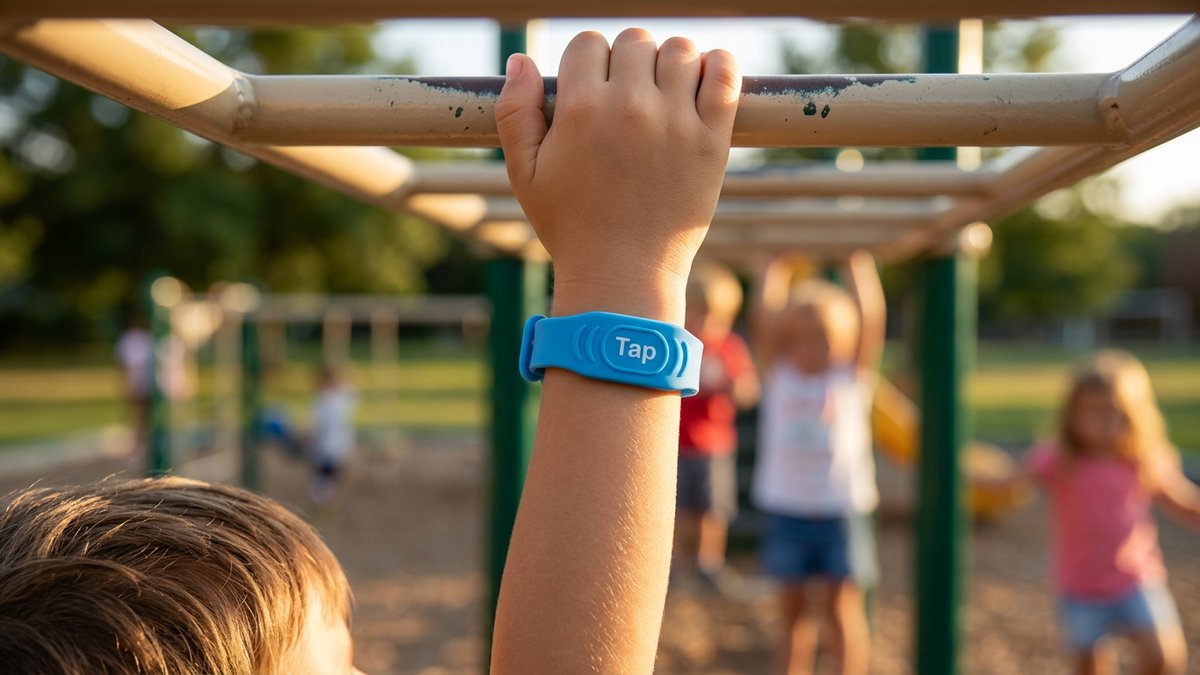
- NFC wristbands: Any person with a smartphone can tap the wristband and instantly see emergency contacts, medical information, and the child's name. No app download required. Works offline.
- GPS trackers: A stranger cannot interact with the device in any meaningful way. There is no mechanism for a bystander to access identifying information or contact the parent.
Privacy
- NFC wristbands: No location tracking. No data transmitted continuously. Information is only shared when someone deliberately taps the wristband.
- GPS trackers: Continuous location data collection. Data stored on company servers. Raises questions about who has access to your child's movement history and how that data is secured.
Range and Connectivity
- NFC wristbands: Work anywhere, anytime, with no signal dependency. The information is stored on the chip itself.
- GPS trackers: Require cellular connectivity and GPS signal. Performance degrades indoors, underground, in dense urban areas, and in rural locations with poor coverage.
Durability for Kids
- NFC wristbands: No screens to crack, no buttons to break, no electronics exposed to daily wear and roughhousing.
- GPS trackers: Electronic devices with screens, buttons, and charging components. Vulnerable to the realities of being worn by active children.
Real-World Scenarios: When Each Technology Shines
The best way to understand these technologies is to see how they perform in situations parents actually face.
Scenario 1: The Theme Park Separation
A family of five visits a large theme park. Their three-year-old wanders away while the parents are managing the older siblings near a ride entrance.
With a GPS tracker, the parents notice the child is missing after several minutes. They check the app, see the child's location, and begin navigating through the crowd. The tracker shows the child near a food court 200 meters away. But the park is packed, the signal is bouncing between buildings, and the location pin keeps shifting. It takes them 15 more minutes to actually locate the child.
With an NFC wristband, a park employee or another parent finds the child within minutes. They tap the wristband with their phone, immediately see the parents' phone numbers, and call directly. The child is reunited with the family in under five minutes, often before the parents have even realized the child is missing.
In this scenario, NFC identification solved the problem faster because it empowered the people closest to the child to take immediate action.
Scenario 2: The After-School Commute
A ten-year-old walks home from school independently for the first time. The parent wants to verify the child is following the expected route and arriving home safely.
An NFC wristband offers no help here. It is not designed to track movement or location in real time.
A GPS tracker, however, is perfectly suited for this use case. The parent can see the child's route, receive arrival notifications through geofencing, and have peace of mind during the transition to greater independence.
This is a clear GPS win, and it highlights an important point: the right technology depends entirely on the specific safety concern you are trying to address.
Scenario 3: The Outdoor Festival
A family attends a large outdoor music festival with their four-year-old. Cellular networks are overwhelmed by thousands of attendees. The GPS tracker on the child's wrist is struggling to maintain a connection and its location updates are delayed by several minutes.
The child slips away during a performance. A nearby family notices the unaccompanied child and tries to help. If the child is wearing an NFC wristband, the situation resolves quickly: a tap reveals the parents' contact information, and a phone call brings everyone together.
This scenario illustrates a critical vulnerability of GPS technology: it depends on infrastructure that is not always available, precisely when you need it most.
What Most Parents Miss: The Privacy and Cost Reality
Two factors tend to be afterthoughts in the child safety tech conversation, but they deserve serious consideration.
The Privacy Question
GPS trackers collect continuous location data about your child. This data typically flows through the manufacturer's servers, where it may be stored, processed, and, depending on the company's privacy policy, potentially shared with third parties.
The Federal Trade Commission has raised ongoing concerns about children's data privacy, and the Children's Online Privacy Protection Act (COPPA) imposes strict requirements on the collection of data from children under 13. Not all GPS tracker companies are fully transparent about their data practices, and security breaches affecting children's location data have been documented multiple times.
NFC identification takes a fundamentally different approach. No data is transmitted until someone physically taps the wristband. No location history is created. No server stores your child's movements. The information shared is limited to what the parent chooses to include, and it is only accessible through deliberate, close-range interaction.
For families who value privacy, or who are uncomfortable with the idea of a company maintaining a detailed log of their child's daily movements, NFC offers a compelling alternative.
The Cost Reality
The true cost of GPS tracking is often obscured by low introductory prices. A typical GPS watch for children costs $50 to $200 upfront, plus $10 to $25 per month for the cellular subscription that makes it functional. Over three years, a family might spend $400 to $1,100 on a single device.
Multiply that across siblings, factor in replacement costs when devices break (and they will, because children are hard on electronics), and the total investment becomes substantial.
NFC wristbands, by contrast, are a one-time purchase with no ongoing fees. The total cost of ownership over three years is whatever you paid on day one.
This is not a minor consideration. For many families, the recurring cost of GPS tracking creates a financial barrier to consistent use. A device that sits in a drawer because the subscription lapsed is not keeping anyone safe.
Age-Specific Considerations: Matching Technology to Your Child's Stage
The right safety technology changes as your child grows. Here is a general framework, though every family should adapt it to their specific circumstances and comfort level.
Toddlers and Preschoolers (Ages 1-5)
At this age, children have no ability to operate technology, make phone calls, or navigate independently. They are most likely to become separated in crowded public spaces, and when they do, they often cannot clearly communicate their name or their parents' contact information.
NFC identification is particularly well-suited for this age group. It requires nothing from the child. It simply provides critical information to any adult who finds them. GPS tracking can complement this, but a toddler's GPS watch is entirely parent-dependent and provides no benefit to a helpful stranger.
Early Elementary (Ages 6-8)
Children in this range are beginning to have more independence but are still closely supervised. They can usually state their name and sometimes a parent's phone number, but may struggle under stress.
NFC identification remains highly valuable as a reliable backup. GPS tracking becomes more useful as children start attending activities, playdates, and events where parents are not physically present.
Older Elementary and Middle School (Ages 9-12)
This is the age of growing independence: walking to school, visiting friends, and exploring the neighborhood. Children can operate devices and communicate effectively.
GPS tracking becomes genuinely useful here, particularly for families navigating the transition to greater independence. NFC identification still provides value as an emergency fallback, especially during travel or large events.
Teenagers (Ages 13+)
Most teenagers resist visible safety devices, and many child safety experts suggest that at this age, open communication and trust-building are more effective than surveillance.
A discreet NFC tag (on a keychain, in a wallet, or on a phone case) can provide emergency identification without feeling intrusive. GPS tracking at this age becomes a family values discussion about trust, privacy, and independence.

Making the Right Choice for Your Family
The NFC vs GPS child tracker debate is not really a debate at all. These technologies serve different purposes, and framing them as competitors misses the point entirely.
The real question is not "which is better?" but rather "what specific safety gap am I trying to fill?" If your primary concern is knowing your child's location in real time, GPS tracking is the right tool. If your primary concern is ensuring your child can be quickly identified and reunited with you when separated, NFC identification is the stronger choice.
The best child safety plan is one you will actually use consistently. A technology that is too expensive, too complicated, or too dependent on charging and connectivity will eventually be left at home. Whatever you choose, choose something your family will stick with, every outing, every time.

TapTap Buddy Team
Our team of child safety experts, parents, and technology specialists is dedicated to creating innovative solutions that keep children safe. With backgrounds in emergency response, pediatric care, and smart technology, we bring real-world experience to every article.
View all articles