Epilepsy Safety for Children: What Caregivers Need to Know
Approximately 456,000 children in the US have active epilepsy, yet most bystanders have never been trained in seizure first aid. This guide covers seizure types, the five-minute emergency rule, rescue medications, school safety plans, and how to ensure critical medical information reaches anyone who needs it.

Quick Answer
When a child has a seizure, stay with them, clear the area of hazards, and position them on their side after convulsions stop. Never restrain them or put anything in their mouth. If the seizure lasts five minutes or longer, call 911 immediately. Every child with epilepsy should have a written seizure action plan shared with all caregivers, including information about any rescue medication.
According to the Centers for Disease Control and Prevention, approximately 456,000 children under the age of 17 in the United States are currently living with active epilepsy. That translates to roughly 1 in every 150 children receiving a diagnosis within the first ten years of life - a number far larger than most people realize. Yet despite how common childhood epilepsy is, most caregivers, teachers, coaches, and family friends have never received any practical training in what to do when a child has a seizure. The gap between knowing a child has epilepsy and knowing how to respond in the moment is wide, and in some situations, it can be dangerous.
The challenge is not just a lack of awareness. It is a lack of accessible, actionable information at exactly the moment it is needed most. A parent can create a detailed seizure action plan with their child's neurologist, share it with the school nurse, and still find themselves in a situation where the person standing next to their child during a seizure - a coach at an away game, a grandparent at a holiday gathering, a stranger at a public park - has no idea what to do, what type of seizure to expect, or whether rescue medication is available. The plan exists, but it is not present.
Epilepsy in children is also widely misunderstood. Public perception of seizures is largely shaped by dramatic depictions of convulsions, but childhood epilepsy encompasses many different seizure types, some of which look nothing like what most people imagine. A child staring blankly for thirty seconds, a child briefly losing muscle tone and slumping, a child experiencing repetitive blinking or lip-smacking - these are all seizures, and they are all situations where an uninformed bystander might not recognize what they are seeing, might not know whether to intervene, and might not know who to call.
This guide is written for the full circle of people around a child with epilepsy: parents and primary caregivers who are building their safety strategy, but also grandparents, teachers, coaches, babysitters, and anyone else who spends time with a child who has a seizure disorder. It covers the different types of childhood seizures, the evidence-based first aid protocol, the critical five-minute rule, how to manage medications and breakthrough seizures, how to communicate seizure information to schools and caregivers, and how modern identification tools can make critical medical information instantly available to anyone who needs it.
Understanding Childhood Epilepsy: What Caregivers Need to Know First
Epilepsy is defined as a neurological disorder characterized by recurrent, unprovoked seizures. According to the Epilepsy Foundation, it is the fourth most common neurological disease globally, and childhood-onset epilepsy is the most prevalent form. A seizure occurs when a sudden surge of abnormal electrical activity in the brain temporarily disrupts normal brain function. The type of seizure a child experiences depends on which part of the brain is affected and how widely the electrical disruption spreads.
For caregivers, understanding the basics of seizure classification is not just academic - it shapes everything from how you recognize a seizure is occurring to what first aid steps are appropriate.
Types of Seizures Common in Children
The International League Against Epilepsy classifies seizures by their point of origin and their behavioral characteristics. The most important distinction for everyday caregivers is between focal seizures and generalized seizures.
Generalized tonic-clonic seizures (formerly called grand mal seizures) are what most people picture. The child loses consciousness, their body stiffens (the tonic phase), and then begins rhythmic jerking movements (the clonic phase). These typically last one to three minutes. A child may be confused, tired, or disoriented for a period afterward - known as the postictal phase.
Absence seizures are brief episodes (typically 5 to 30 seconds) in which a child appears to stare blankly, often with subtle eyelid fluttering or lip movements. The child does not fall, does not convulse, and often resumes activity immediately after, sometimes unaware anything happened. These are frequently mistaken for daydreaming and can be dismissed for months before diagnosis.
Focal (partial) seizures originate in one part of the brain and may cause unusual sensations, emotions, or behaviors in one part of the body. A child might experience repetitive movements of one hand, turn their head to one side, or have a brief episode of automatic behaviors like chewing or fidgeting. Focal seizures may or may not involve loss of awareness.
Atonic seizures (drop attacks) involve a sudden loss of muscle tone, causing the child to slump or fall to the ground abruptly. These are brief but carry a high risk of head injury. Children with frequent atonic seizures sometimes wear protective helmets.
Myoclonic seizures involve sudden, brief muscle jerks - often in the arms or shoulders - that can cause a child to drop objects or fall. They typically last just a second or two.
Understanding which type of seizure your child experiences, and ensuring that information is accessible to every caregiver in the child's life, is foundational to seizure safety.
Why Breakthrough Seizures Happen
Research published through the Epilepsy Foundation consistently identifies missed medication doses as the single most common cause of breakthrough seizures in children who otherwise have well-controlled epilepsy. Anti-seizure medications work by maintaining a stable therapeutic level in the bloodstream - even a single missed dose can lower that level enough to trigger seizure activity in a susceptible child.
Other common triggers include illness and fever, sleep deprivation, stress, and for some children, specific environmental stimuli like flashing lights (photosensitive epilepsy). Caregivers should be familiar with any known triggers specific to the child in their care and understand that not every seizure signals a new problem - some are entirely predictable responses to identifiable circumstances.
The Seizure First Aid Protocol Every Caregiver Must Know
When a generalized tonic-clonic seizure begins, most people's instinct is to do something - to restrain the child, to put something in their mouth, to lift them. According to the Epilepsy Foundation's seizure first aid guidelines, almost all of those instinctive responses are wrong and some can cause harm. Effective first aid for most seizures is primarily about what you do NOT do.
The Three Core Steps: Stay, Safe, Side
The Epilepsy Foundation simplifies seizure first aid into three words: Stay, Safe, Side.
- Stay with the child. Do not leave them alone during or immediately after the seizure.
- Keep the child Safe by clearing the area of hard or sharp objects. Cushion their head with something soft if possible. Do not restrain the child's movements - you cannot stop a seizure by holding someone down, and restraint can cause injury.
- Once convulsions stop, roll the child onto their Side in a recovery position. This prevents saliva or vomit from causing choking.
Additional guidance from the Epilepsy Foundation and American Academy of Pediatrics includes:
- Never put anything in the child's mouth. The old advice about preventing people from "swallowing their tongue" is medically inaccurate - a person cannot swallow their tongue. Objects placed in the mouth during a seizure commonly cause broken teeth, jaw injuries, and injuries to the person trying to help.
- Do not give water, food, or medication by mouth until the child is fully awake and alert.
- Remove glasses if the child wears them.
- Loosen anything tight around the neck, such as a collar or scarf.
- Time the seizure from the first moment it begins. This information is critical for medical personnel.
- Stay calm and speak to the child in a reassuring voice as they regain awareness. The postictal period (following a tonic-clonic seizure) can be frightening and disorienting for the child.
Absence and Focal Seizures: A Different Response
For absence seizures and some focal seizures, the first aid guidance differs. Because the child may not fall or convulse, the primary goal is safety and observation:
- Stay near the child and calmly guide them away from hazards (stairs, water, streets) if they are moving.
- Do not grab or restrain the child unless they are in immediate danger.
- Do not try to stop automatic movements or behaviors.
- Speak calmly after the seizure. The child may be confused or embarrassed.
- Document what you observed - duration, behaviors, what the child was doing before it began - for their medical team.

The Five-Minute Rule: Recognizing a Medical Emergency
This is one of the most important facts any caregiver of a child with epilepsy needs to know: any single seizure lasting five minutes or longer is a medical emergency called status epilepticus.
Status epilepticus is not simply a long seizure. It is a condition in which the brain's normal mechanism for stopping a seizure fails. According to research reviewed by the Epilepsy Foundation, a seizure that continues for five or more minutes is unlikely to stop on its own without medical intervention, and the longer a seizure continues, the greater the risk of brain injury, respiratory compromise, and other life-threatening complications.
When to Call 911 Immediately
Call 911 without hesitation in any of the following situations:
- The seizure lasts five minutes or longer - or if you are uncertain how long the seizure has been occurring, call immediately.
- The child does not regain consciousness or does not return to their normal state within a reasonable time after the seizure appears to end.
- A second seizure begins shortly after the first without a recovery period in between.
- The child is injured during the seizure (head injury, fall from height, etc.).
- The child has difficulty breathing after the seizure.
- The seizure occurs in water (bath, pool, lake). Seizures in water carry a high risk of drowning even in shallow water.
- It is the child's first known seizure - all first seizures warrant medical evaluation.
- You are uncertain whether the child has a known seizure condition or what their action plan is.
That last point is particularly important. A first responder or bystander who does not know a child's medical history cannot make the same judgment calls that an informed parent can. When in doubt, calling 911 is always the right decision.
Rescue Medications and When They Are Used
Many children with epilepsy who are at risk for prolonged seizures are prescribed a rescue medication - a fast-acting drug designed to stop a seizure quickly when administered outside a hospital setting. Common rescue medications include diazepam rectal gel (Diastat), intranasal midazolam (Nayzilam), and intranasal diazepam (Valtoco).
These medications are typically prescribed with a specific protocol: administer if a seizure lasts longer than a specified number of minutes (often three to five minutes, as determined by the child's neurologist) and a seizure has not stopped on its own. After rescue medication is given, medical personnel should still be notified.
The critical issue is that rescue medication only helps if the people present know it exists, know where it is, and know when and how to use it. A rescue medication kept in a bag in the car does not help a child having a seizure at the playground. A rescue medication at school does not help a child having a seizure at a soccer game. Ensuring that anyone who might need to administer rescue medication knows it exists and has access to the protocol is an essential part of a complete seizure safety plan.
Building a Seizure Action Plan
A seizure action plan (SAP) is a written document, developed with the child's neurologist, that provides specific, individualized guidance for responding to that child's seizures. According to the American Academy of Pediatrics, every child with epilepsy should have an up-to-date SAP and it should be shared with every adult who cares for the child.
A comprehensive seizure action plan typically includes:
- The child's name, age, weight, and a current photo
- Type or types of seizures the child experiences
- What a typical seizure looks like for this child (important because the same seizure type can manifest differently across individuals)
- Known triggers
- Typical seizure duration and what to expect afterward
- Step-by-step first aid instructions specific to the child's seizure type
- Rescue medication name, dose, location, and administration instructions
- Clear criteria for when to call 911
- Emergency contact information (primary caregiver, secondary caregiver, neurologist)
- Current medications and schedule
The plan should be written in plain language - clear enough that someone who has never seen a seizure could follow it. Medical jargon should be minimal or explained.
Distributing the Seizure Action Plan
A plan that stays in the neurologist's file protects no one. Every adult in a child's regular life should have access to a current version:
- School nurse, classroom teacher, and any substitute teachers
- School bus driver and aide
- Sports coaches and activity leaders
- Extended family caregivers (grandparents, aunts, uncles)
- Regular babysitters and childcare providers
- Parents of close friends whose homes the child visits
This is where the logistics become genuinely difficult. Maintaining paper copies is cumbersome, keeping them current is challenging, and in a fast-moving situation, a binder full of documents is not the most accessible format. Digital solutions have made this significantly more manageable.
Epilepsy Safety at School: What Parents and Educators Need to Know
According to the Epilepsy Foundation, school is where many children spend the majority of their waking hours, and seizures at school are common. A well-prepared school environment requires more than just a nurse who knows the plan - it requires a coordinated approach across multiple adults.
Creating an Effective School Seizure Plan
Beyond the general seizure action plan, schools often use a more detailed Individual Health Plan (IHP) or 504 accommodation plan that addresses:
- Which staff members are trained and authorized to administer rescue medication
- Where rescue medication is stored and how it is accessed
- The notification chain when a seizure occurs (who calls the parent, when, what they say)
- Academic accommodations for seizure-related cognitive effects (memory, concentration, medication side effects)
- Anti-stigma strategies to protect the child's social experience
- Field trip and after-school activity protocols
The Epilepsy Foundation's School Program offers training resources for educators and template documents that families can adapt.
Addressing the First Responder Misidentification Risk
One underappreciated risk in the school and community setting is misidentification. Emergency responders arriving at the scene of a seizure without prior knowledge of the child's history may take actions inconsistent with the child's established care plan - particularly if the seizure appears unusual or atypical. In some cases, automated external defibrillators have been incorrectly applied, or rescue breathing has been initiated unnecessarily.
Providing first responders with accurate, immediate information - the child's diagnosis, their seizure type, whether rescue medication has been administered, and the contacts who should be notified - reduces the risk of unnecessary interventions and accelerates appropriate care.
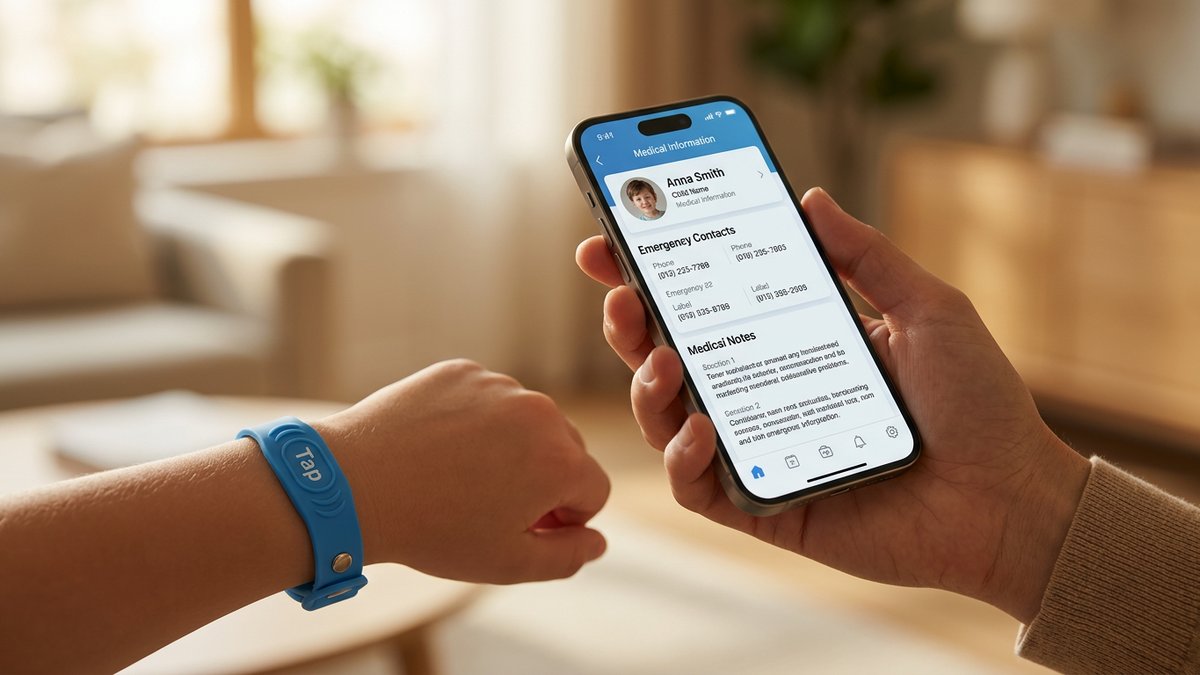
This is also a scenario where a visible, easily-tapped NFC medical wristband adds genuine value: the information the first responder needs to provide the right care is available the moment they kneel next to the child, before the child can speak or before a parent is reached.
Communicating with Caregivers: Practical Strategies
Parents of children with epilepsy often navigate the challenge of balancing transparency with the desire to protect their child from stigma or unnecessary anxiety. Both concerns are valid, but research suggests that informed caregivers provide significantly better emergency response than uninformed ones. Here is a framework for approaching these conversations:
The Briefing Approach
Rather than handing every caregiver a multi-page document, many parents find success with a structured, brief verbal orientation supplemented by written backup. Cover:
- The diagnosis: "Our daughter has epilepsy and experiences absence seizures. They look like this..." (describe specifically)
- The protocol: "If you see this, here is what to do..." (walk through the first aid steps)
- The escalation rule: "If a seizure lasts more than five minutes, or if you're ever uncertain, call 911 and then call me."
- The medication: "She has rescue medication in her bag. Here is where it is and when to use it." (show, do not just describe)
- The contact chain: "Here is how to reach me immediately."
End with: "Do you have any questions? Does this feel manageable to you?" Giving caregivers the opportunity to ask questions reduces anxiety and increases confidence.
Updating Caregivers When Things Change
Epilepsy treatment evolves. Medication changes, seizure types may shift, and action plans are periodically revised. Every time the seizure action plan changes, every caregiver who holds a copy needs to be updated. A digital or NFC-based profile that can be updated in one place and is immediately current for anyone who accesses it solves a genuine logistical problem for families managing these updates across multiple caregivers.
Managing Epilepsy Day to Day: Quality of Life and Safety Together
Children with epilepsy can and do live full, active, and happy lives. With appropriate precautions - which are often less restrictive than parents initially fear - most activities remain accessible. The goal is not to limit a child's world but to make their participation in it safer.
Water Safety
Water is the single most significant environmental hazard for children with epilepsy. A seizure that occurs in as little as two inches of water can result in drowning. The Epilepsy Foundation recommends:
- Baths should be supervised directly (adult present in the bathroom) or replaced with showers for older children, with a shower chair available
- Swimming should always involve direct supervision from an adult who knows the child has epilepsy - not general lifeguard supervision from a distance
- Open water swimming (lakes, ocean) carries higher risk due to reduced visibility and longer response times
- Life vests should be worn during boating and water sports, even if the child is a strong swimmer
Sports and Physical Activity
Physical activity is beneficial for children with epilepsy - it supports overall health, mood, and social development. Most sports are appropriate with reasonable precautions. The neurologist can advise on any sport-specific restrictions based on the child's specific seizure type and control status.
Helmeted sports (cycling, skateboarding, hockey, football) provide incidental protection during a potential seizure. Contact sports and high-altitude activities warrant discussion with the neurologist. Team coaches and activity leaders should always be part of the informed caregiver circle.
Medication Management
Because missed doses are the most common trigger for breakthrough seizures, medication management is a safety issue, not just a compliance issue. Practical strategies include:
- Use a pill organizer or smart pill dispenser with alarms to prevent missed doses
- Keep a small travel supply of medication accessible during outings, in addition to the primary supply at home
- When a dose is missed, follow the specific instructions from the prescribing neurologist (do not double-dose without guidance)
- Communicate medication schedule changes immediately to all primary caregivers who may be responsible for administration
- Coordinate with the school nurse for any doses that fall during school hours
Talking to Your Child About Their Epilepsy
Children who understand their own epilepsy are better equipped to participate in their safety, advocate for themselves, and manage the emotional dimensions of living with a chronic condition. The American Academy of Pediatrics encourages age-appropriate disclosure and conversation.
For younger children, the explanation can be simple: "Your brain sometimes gets too excited and needs a little reset. When that happens, your body does this... and this is what the people around you will do to help." Framing it in terms of the people around them taking care of them can be reassuring.
For older children and teenagers, a more detailed understanding of their diagnosis, their medications, and their own action plan is appropriate and empowering. Teenagers especially benefit from understanding their own triggers, being partners in medication management, and knowing how to communicate their needs to new people in their lives.
Some children feel stigma around their epilepsy and resist wearing medical identification or disclosing their diagnosis. This is a real and valid concern. Having an honest conversation about why identification matters - "if something happens and I am not there, this is how someone will know how to help you" - and allowing the child input into how their information is presented can increase cooperation.

Building Your Child's Complete Safety Network
A child with epilepsy is safest when surrounded by a network of informed, prepared adults who know what to look for, know what to do, and can reach each other and the child's medical team quickly. Building that network is not a one-time task - it requires ongoing communication as the child's care plan evolves, as new caregivers enter the picture, and as the child's own independence grows.
The components of a complete safety network include:
- An up-to-date seizure action plan developed with the neurologist and reviewed at least annually
- Trained primary caregivers who have practiced the first aid protocol, not just read it
- School personnel with a formal Individual Health Plan and trained staff for rescue medication administration
- Extended caregivers (coaches, family, sitters) who have received a briefing and have the emergency contact information they need
- Accessible medical identification that communicates the most critical information to any bystander or first responder, regardless of whether they have been previously briefed
The goal of this network is not to keep a child in a protective bubble. It is to make sure that wherever the child is and whoever they are with, the knowledge needed to keep them safe travels with them.

TapTap Buddy Team
Our team of child safety experts, parents, and technology specialists is dedicated to creating innovative solutions that keep children safe. With backgrounds in emergency response, pediatric care, and smart technology, we bring real-world experience to every article.
View all articles