How to Educate Other Parents About Child Safety Solutions
More than 1,000 children go missing in the US every day, yet most parents have no ID materials prepared and few communities have a culture of proactive child safety readiness. This guide shows how ordinary parents can spread practical safety habits through the conversations they are already having.

Quick Answer
Start by getting your own family prepared - update your child's ID file, set up a digital emergency profile, and practice safety protocols together. Then bring the conversation naturally into playgroups, PTA meetings, and sports clubs by sharing your own experience rather than statistics. Peer-to-peer advocacy spreads safety habits faster than institutional campaigns because people act on recommendations from people they trust.
Every single day, more than 1,000 children go missing across the United States. In 2024, the National Center for Missing and Exploited Children (NCMEC) assisted law enforcement with 29,568 missing child cases - a number that represents real families frozen in fear, real communities mobilized in search, and real children whose safety depended on adults being prepared. The speed of response in those first hours is not a detail. It is everything.
Yet most parents move through daily life without a concrete safety plan for the one moment that matters most. Not because they do not care - every parent reading this cares deeply - but because child safety preparedness has historically been treated as an institutional problem. Schools, police, and nonprofits were supposed to handle it. What has been missing is a peer-to-peer culture: neighbors talking to neighbors, parents raising it at soccer practice, a friend mentioning it at a playgroup. The conversations that spread safety faster than any campaign.
There is a painful irony at the center of this problem. When the National Child ID Program launched its fingerprint and photo ID kit initiative, surveys found that fewer than 2% of parents had any identifying materials prepared for their children. The tools existed. The knowledge did not spread the way it needed to. And the gap between "this tool exists" and "every parent in my circle knows about and uses it" is a gap that can only be closed by other parents.
This guide is about how to be that parent. How to bring child safety into the conversations you are already having - with neighbors, PTA members, sports coaches, and friends - and how to lead a culture shift without being preachy, alarmist, or overwhelming. Along the way, it will cover the practical knowledge base you need: what today's safety tools actually do, how to talk about preparedness with different audiences, and how the parent community can work together to surround children with a safety net that no institution can build alone.
Why Parent-to-Parent Advocacy Closes the Safety Gap
Formal child safety programs have reached millions of families. NCMEC alone reached more than 10,500 parents and caregivers with safety education in 2024. Head Start programs require injury and safety protocols under federal regulation 1302.47, and the CDC's National Action Plan for Child Injury Prevention outlines strategies across every level of the child safety ecosystem.
And yet the awareness gap persists. Why?
Because institutions speak in campaigns, and people listen to their friends.
Research consistently shows that behavior change is more likely when recommendations come from trusted peers rather than authority figures. A flyer from a school about child identification kits gets filed away. A conversation with a friend at pickup who says "hey, have you heard about this?" gets acted on by the weekend.
The Parent Network Multiplier
Think about how other safety habits spread. Car seat installation checks became part of new parent culture largely because hospitals, nurses, and other parents all reinforced the same message in trusted relationships. Bike helmet use went from rare to nearly universal partly because neighborhood norms shifted - when every kid on the block wore one, the holdouts felt the social gravity.
Child safety identification works the same way. The more households in a given community that are prepared, the more likely that any given found child will be quickly and correctly helped. When safety habits cluster geographically, the entire neighborhood becomes a more capable first responder.
Why Schools and Institutions Cannot Do This Alone
Institutional safety programs face structural limits. They operate in scheduled windows, reach parents who are already engaged, and communicate through channels that compete for attention against dozens of other school communications. A Gallup survey on school safety found that parent concern about school safety has remained elevated for four consecutive years, with a significant share of parents feeling that schools are less safe than they were a decade ago. Parental anxiety is high - but anxiety without actionable habits does not protect children.
The horizontal conversation among parents fills the gap. When a parent explains to another parent - calmly, practically, person-to-person - what they do to prepare their child for outings, it is information delivered in the context of trust, specificity, and shared stakes. That conversation is disproportionately powerful relative to any institutional equivalent.
The Stakes: What the First 48 Hours Actually Mean
Understanding why child safety preparation matters starts with understanding what the research says about timing. The statistics here are not shared to frighten, but to establish why preparation before an incident is the only preparation that counts.
When a child goes missing, the clock starts immediately. Law enforcement and child safety researchers consistently emphasize that the first hours are the most critical for safe recovery. According to the Department of Justice's Office of Justice Programs, the first 48 hours after a child's disappearance are the most chaotic and the most consequential. Children who are not found quickly face a rapidly escalating risk profile.
Research cited by child protection organizations indicates that a missing or runaway child can be propositioned for exploitation within 2 to 48 hours of going missing. For children who end up on the street without a safe destination, estimates suggest that up to 60% are approached by a trafficker within the first 48 hours. These are not hypothetical risks reserved for extraordinary circumstances. They are the documented outcomes of ordinary separations that escalated.
The Identification Bottleneck
Here is what most parents do not know: when a child is found by a well-meaning stranger or first responder, the single biggest obstacle to reunion is often identification. A toddler cannot reliably state a parent's phone number, especially under stress. A child with a developmental or speech difference may not communicate at all. Bystanders who find an unaccompanied child want to help but have no mechanism to do so without identifying information.
The National Child ID Program, which provides fingerprint and DNA identification kits to families through community distribution, was created specifically to address this bottleneck. When the program launched, surveys revealed that fewer than 2% of parents had usable ID materials prepared - no current photo, no fingerprints on file, no written record of identifying features. That statistic has improved over time, but the underlying problem remains: most families are not prepared to give law enforcement the head start they need.
Building Your Knowledge Base Before the Conversation
The most effective parent advocates are the ones who speak from practical experience, not abstract concern. Before you bring child safety up at your next playgroup or PTA meeting, it helps to have done the work yourself - to have explored the tools, set them up, and formed genuine opinions about what is useful.
Core Preparedness Practices Every Parent Should Know
Create and maintain an up-to-date child ID file. This is the foundational recommendation from the National Center for Missing and Exploited Children and the National Child ID Program. The file should include a current, high-quality photograph, physical description including height and weight, fingerprints, any distinctive features or medical information, and a DNA sample if using a dedicated ID kit. Experts recommend updating this file at least once a year, or after any significant physical change.
Know your child's basic information by heart. Practice with your child so that they can state their full name, at least one parent's phone number, and their address. Children as young as four can learn this with repetition. For very young children or those with developmental differences, this step may not be reliable under stress - which is exactly why external identification tools become more important.
Establish meeting points and safe person protocols. Teach children that if they become separated in a public place, they should stay in one spot if possible, and approach a store employee, security guard, or another family (a parent with children) if they need help. Practice this at least once in a real-world environment.
Understand the tools available today. Paper ID kits were the standard for decades - and they are still valuable. But modern identification technology has expanded the options significantly. NFC-enabled wristbands, QR code tags, and digital profile systems allow any person with a smartphone to access a child's emergency contact information within seconds, without an app, without cellular signal, and without any action required from the child. These tools represent a meaningful upgrade from hoping a child can remember a phone number under duress.
Teaching Children Body Safety Fundamentals
Child safety advocacy is not only about what happens after a separation. According to Prevent Child Abuse America, body safety education - teaching children about personal boundaries, appropriate and inappropriate touch, and safe adult relationships - is one of the most evidence-supported prevention tools available to parents.
- Teach children the correct anatomical names for body parts from an early age.
- Clearly explain the concept of private parts and why they are private.
- Establish that no adult should ask them to keep secrets from their parents.
- Practice the concept of "no means no" across everyday situations, including physical affection from relatives.
- Create a home culture where children can tell you anything without fear of punishment.
The Child Advocacy Center offers educational resources for both parents and children on these topics, including materials suitable for classroom settings.
How to Raise Child Safety in Everyday Parent Conversations
One of the most common reasons parents do not bring up child safety with peers is the fear of coming across as alarmist or judgmental. The trick is framing. There is a significant difference between "you should really have your kids' IDs on file, it is shocking that most parents don't" and "I just set something up for my kids that I wish I had done sooner - have you heard about this?"
The second framing works because it is honest, personal, and curious rather than prescriptive.
At Playgroups and Informal Gatherings
Informal settings are actually the most powerful channel for spreading safety habits, because the trust level is already high and the context is specifically about children. Here are natural entry points:
- When planning an outing together ("hey, before we take the kids to the fair, I was thinking about what we would do if someone got separated")
- After seeing a news story ("that story about the missing child reminded me to update my daughter's ID photo - I had been meaning to for months")
- When a child demonstrates a safety skill ("she actually learned her phone number - we have been practicing. Does your son know yours yet?")
The goal is not to deliver a lecture but to open a conversation. Share what you have done, what you found useful, and invite them to share what they know. Most parents are grateful for the information and surprised they had not thought about it in those terms.
At PTA Meetings and School Committees
Parent-teacher organizations are already structurally oriented toward collective child wellbeing. Raising child safety as an agenda item is completely appropriate, and PTAs often have both the platform and the relationships to create lasting community change. According to the National PTA's position statement on child safety, PTAs are explicitly called to advocate for the safety and well-being of all children in their communities.
Practical steps for raising child safety at a PTA:
- Contact the meeting organizer ahead of time and request a short slot on the agenda - five to ten minutes is enough to introduce an idea and generate discussion.
- Frame the topic around a specific, actionable proposal rather than a general concern. "I would like to suggest we host a child ID and safety resources event for families this semester" is more effective than "I want to talk about child safety."
- Come prepared with one or two concrete resources to share: the NCMEC's KidSmartz program, the National Child ID Program's free kit information, or a demonstration of a digital identification tool.
- Offer to lead or co-lead a follow-up committee or event rather than expecting the institution to carry it forward.
- Connect with the school counselor or resource officer beforehand if possible - having a school staff member endorse the initiative significantly increases uptake.
At Sports Clubs and After-School Activities
Youth sports and after-school activity environments are high-value venues for safety conversations because they involve children in situations where parents are sometimes managing multiple children simultaneously, transitions between supervised and unsupervised areas are common, and the community of families is already connected through a shared interest.
Coaches, activity directors, and club coordinators are often receptive to receiving brief safety resources to share with their parent groups. A simple handout or digital resource shared through a team group chat can reach dozens of families with almost no friction.
Choosing and Demonstrating Modern Child Safety Tools
When you are advocating for preparedness in your parent community, being able to demonstrate a tool is far more persuasive than describing one. Here is a practical overview of the key categories of child safety identification technology available today, with guidance on how to present each to other parents.
Paper-Based Child ID Kits
These remain the most widely recommended baseline resource, endorsed by NCMEC, the National Child ID Program, and law enforcement agencies across the country. A complete ID kit provides law enforcement with the information needed to issue an AMBER Alert or begin a formal investigation immediately, without waiting for family members to gather materials in a state of panic.
When recommending ID kits to other parents, emphasize the emotional clarity argument: setting one up when everything is fine is easy. Setting one up after a child goes missing, while terrified, under pressure to cooperate with police, and trying to remember when you last updated the photo - that is needlessly hard. Five minutes now removes a significant burden in the worst possible moment.
Digital Emergency Contact Profiles
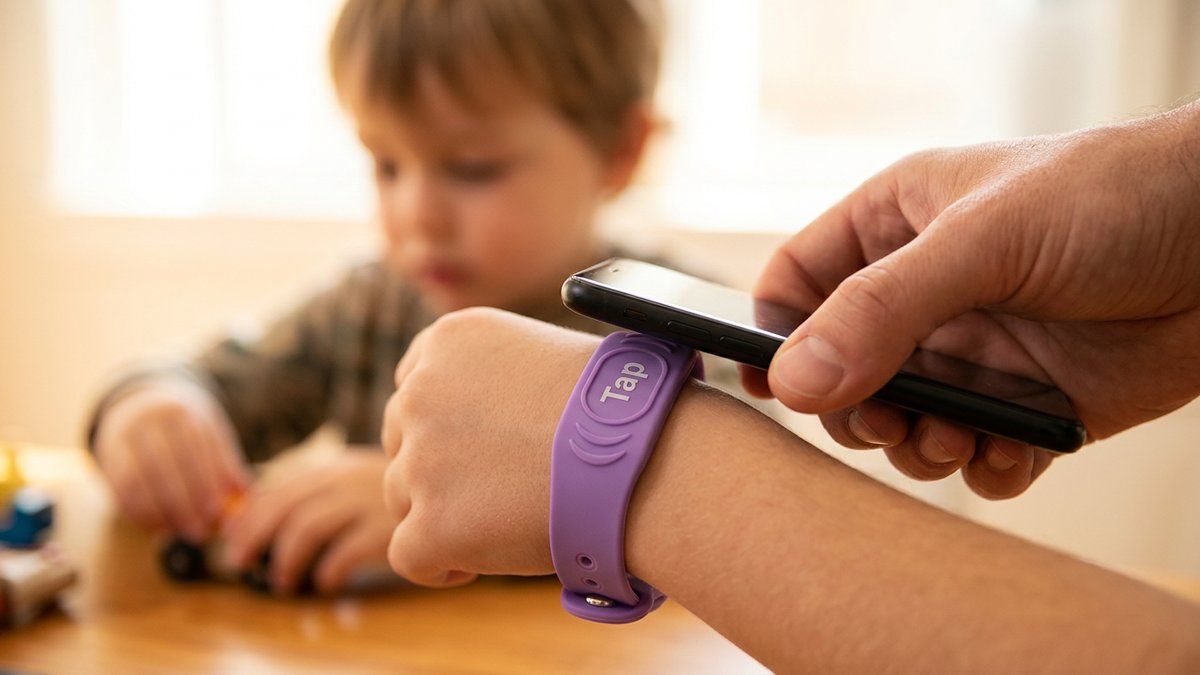
Modern digital identification goes well beyond paper. Today's tools allow parents to create a digital profile for their child that any person with a smartphone can access instantly - no app download required - by tapping an NFC chip or scanning a QR code embedded in a wristband, keychain tag, or clip-on device.
The critical difference between digital and paper ID is accessibility in the moment of need. When a bystander finds an unaccompanied child, they do not have access to the paper ID kit stored at home. They have their phone. A profile accessible by a tap of that phone puts reunion information in the hands of the person physically positioned to help.
What to Look for When Recommending Any Tool
When other parents ask your opinion on a specific product or system, here are the criteria worth sharing:
- Works without an app: the more frictionless the access, the more likely a good samaritan will actually use it
- No signal dependency: the situations where children get separated are often exactly the situations where cellular networks are overwhelmed (crowded events, busy parks)
- Parent controls what is shared: the profile should be editable, and parents should be able to limit personal information to only what is necessary for a reunion
- Durable for real-world kids: any wearable device must survive swimming, sports, and the general roughness of childhood
- No ongoing subscription: a safety tool that lapses when a subscription goes unpaid is a safety gap waiting to happen
Handling Pushback and Common Hesitations
Not every parent you talk to will be immediately receptive. Some common objections come up in these conversations, and having thoughtful responses prepared helps keep the dialogue productive.
"I do not want to make my kids anxious about getting lost."
This is one of the most common concerns, and it is worth taking seriously. The answer is in the framing. Safety preparation, done well, is empowering rather than frightening. Children who practice what to do if they get separated - stay calm, find a safe adult, wait in one spot - are less likely to panic, not more likely. The same is true for parents. Preparedness reduces anxiety because it replaces uncertainty with a plan.
"My kids are always with me, so this is not really an issue."
Every parent of a child who was found unaccompanied believed the same thing beforehand. The situations that create separation - a momentary crowd surge, a child who darts unexpectedly, a distraction that lasts thirty seconds too long - are not failures of parenting. They are features of being in public spaces with children. Preparation is for the scenario you did not plan.
"I already have Find My [phone] set up for my teenager."
Phone-based tracking tools are useful for older children who consistently carry and charge a device. For young children, children who may not have phones, and any situation involving a dead battery or an unaccompanied child who needs help from a stranger, phone location tracking has significant gaps. The value of identification tools is precisely that they do not require the child to have or use any device.
"It seems like a lot of work to set up."
This is actually an easy one to address: a digital ID wristband typically takes less time to set up than creating a social media profile. And a paper ID kit takes about five minutes per child to complete. The perceived friction of these tools is almost always higher than the actual friction.
Creating Lasting Safety Culture in Your Community
The goal of parent-to-parent advocacy is not just to help the parents you talk to today. It is to shift the ambient culture of your community so that child safety preparation becomes an expected norm - something everyone does, like car seats or bike helmets, because that is simply what families in this community do.
That kind of culture shift does not happen through a single conversation. It builds through consistent reinforcement across multiple social contexts over time.
Practical Steps for Community-Level Impact
- Follow up: after a first conversation with a parent about ID kits or wristbands, check in a week later to see if they set it up. Accountability between friends is a powerful motivator.
- Lead by example publicly: wearing a TapTap Buddy wristband on your child at a community event is a conversation starter. When another parent notices it and asks, you have a natural opening.
- Bring it to your faith community: religious communities gather families regularly and often have mechanisms for sharing practical family resources. A five-minute mention from a trusted community leader can reach hundreds of households.
- Normalize it at birthday parties and larger gatherings: if you are hosting a children's party, a brief mention of the meeting point protocol ("if you cannot find your child, come to me and we will go to the front entrance together") models preparedness as a social norm, not an overreaction.
- Share resources digitally: a straightforward message in a neighborhood group, school parent chat, or community board can reach dozens of families with the link to the NCMEC's KidSmartz page or the National Child ID Program kit request form.

A Practical 30-Day Plan for Parent Safety Advocates
If you want to move from intention to action, here is a simple month-long plan that builds your own preparedness while expanding the conversation to your community.
Week 1: Get Your Own House in Order
- Update or create child ID files for each of your children
- Set up digital emergency contact profiles and link them to wristbands or keychain tags
- Practice emergency protocols with your children (safe adults, what to say, where to wait)
- Save NCMEC's 1-800-THE-LOST in your contacts
Week 2: Start the Conversation
- Bring up child ID preparedness with one or two close parent friends in a natural context
- Share a relevant resource (NCMEC's free resources page, the National Child ID Program kit) without pressure
- Mention what you set up and why you found it useful
Week 3: Expand to a Community Setting
- Raise the topic at a PTA meeting, sports practice, or community gathering
- Offer to share a brief resource handout or send a message to a parent group
- Propose a future event if there is interest - a "child safety night" with a guest speaker from a local school counselor, pediatrician, or child advocacy organization
Week 4: Sustain the Momentum
- Follow up with parents from Weeks 2 and 3 to see if they have taken any steps
- Identify one or two parents in your community who might become ongoing co-advocates
- Set a calendar reminder to update your own child ID files in six months

TapTap Buddy Team
Our team of child safety experts, parents, and technology specialists is dedicated to creating innovative solutions that keep children safe. With backgrounds in emergency response, pediatric care, and smart technology, we bring real-world experience to every article.
View all articles