How to Coordinate with Teachers About Safety Tags
Most parents submit an emergency form at registration and assume the school has it covered. But classroom teachers - and especially substitute teachers - often have no direct access to that information when it matters most. This guide shows parents exactly how to coordinate with teachers, specialist staff, and school nurses before something goes wrong.

Quick Answer
To coordinate with your child's teacher about safety tags, send a brief email at the start of the school year with your direct contact number, a backup contact, and any critical medical information. Demonstrate your child's NFC safety wristband at back-to-school night - teachers can tap it with any smartphone to instantly access your child's full emergency profile, no app required. Repeat this introduction with specialist teachers, the school nurse, and substitute teachers.
Every school morning, millions of parents send their children through a door and into the care of someone else. For most families, the emergency contact form submitted at registration feels like a reasonable safety net - a document on file at the front office that the right person will consult if something goes wrong. But there is a structural problem with that assumption, and it is one that very few school safety conversations actually address.
The classroom teacher - the adult your child is with for six to seven hours every day - often has no direct, immediate access to your child's emergency information. The nurse has a file. The office has a binder. But the teacher standing in front of thirty students during a fire drill, or the substitute who showed up that morning having never met your child, has no way to pull up your child's allergies, their emergency contacts, or the medical condition you carefully documented last August.
This is not a failure of the school. It is a structural gap in how emergency information flows. And it is a gap that parents can do something about - starting with a single conversation before the school year gets underway.
This article is a practical guide to having that conversation. It covers what teachers actually need to know, how to coordinate with specialist staff and substitutes, how to introduce a modern safety identification tool into the classroom context without making it a complicated ask, and how to keep the whole system current throughout the year.
Why Teachers Need More Than the Office Emergency Form
When a medical emergency or safety incident happens in a classroom, seconds matter. The teacher's first instinct is to help the child - not to call the office, wait on hold, and ask someone to read from a paper form. In that moment, information needs to be immediately at hand.
The gap becomes even more pronounced in three specific situations.
The Substitute Teacher Problem
Substitute teachers represent one of the least-discussed safety vulnerabilities in school systems. A substitute may have never met your child, may not have been briefed on class routines, and - critically - may not know which students have allergies, seizure disorders, epipen prescriptions, or other conditions that require immediate response.
A substitute does not have the same familiarity with the classroom roster that a regular teacher develops over weeks and months. They cannot spot a child having an allergic reaction because something looks "off" the way a classroom teacher would. They are starting from zero - and in a room of twenty-five or thirty children, that is a meaningful gap.
Campus Safety Magazine has highlighted substitute teacher preparedness as one of the systemic challenges school administrators regularly cite in safety planning. The problem is widely acknowledged. The practical solution at the individual family level is less commonly discussed.
Field Trips and Off-Campus Activities
When a class leaves the school building, it leaves behind the office binder. Teachers on field trips often carry paper emergency cards for the students in their group - but these are frequently incomplete, outdated, or missing details that were added to the main record after the card was printed.
A child who develops an allergic reaction at a museum, or who wanders from a group at an outdoor education site, is in a situation where a stranger or a first responder may be the first adult on scene. In that scenario, a physical identifier on the child that any adult can read without any special equipment or prior knowledge becomes one of the most useful safety tools available.
After the Bell: Enrichment Programs and School Clubs
Many families assume that afterschool care coordinators and enrichment program staff have access to the same emergency records as the main school. Often, they do not. After-school programs operated by third-party vendors, community organizations, or parent cooperatives may have entirely separate enrollment forms and may not have visibility into the records the school nurse holds. The coordination challenge multiplies whenever your child is in the care of someone outside the main school infrastructure.
What to Tell Your Child's Teacher Before the School Year
The beginning of a new school year is the optimal window for this conversation. Teachers are in setup mode, they are learning who their new students are, and they are generally receptive to parent communication about specific student needs.
Your goal is not to alarm the teacher or present them with a complicated system to manage. Your goal is to make sure that if something happens, they have what they need within arm's reach.
Start With a Brief Email or Back-to-School Night Conversation
The medium matters less than the timing and the tone. A brief message sent during the first week of school, or a two-minute conversation at back-to-school night, is far more effective than a phone call in week six when routines are already established.
A useful opening frame is simply: "I wanted to make sure you have all of my contact information and anything relevant about [child's name] that might be helpful if there's ever an issue during the school day."
This framing positions you as prepared and considerate, not anxious or demanding. Teachers receive a lot of parent communication, and the clearest signal you can send is that you are organized, brief, and focused on being useful.
The Five Things Every Teacher Should Know
Before the conversation, gather these five pieces of information in a format you can hand over or send:
- Your full name and a direct cell phone number that you answer - not a work number that routes to voicemail
- A second emergency contact who can be reached if you are unavailable
- Any allergies or medical conditions, with clear guidance on what to do and what not to do
- Any behavioral, sensory, or communication considerations that affect how your child responds under stress
- Whether your child has a 504 plan, IEP, or any other formal accommodation that intersects with emergency response
The fifth point is particularly important and often overlooked in informal parent-teacher safety conversations. A child with autism spectrum disorder, anxiety, or a sensory processing condition may respond to a fire alarm or lockdown drill in ways that look alarming to a teacher who was not prepared. Giving the teacher that context before something happens is one of the most practical things a parent can do.
Putting It on the Child as Well as the File
Here is where coordination moves from paperwork to physical safety infrastructure. The teacher can do everything right - remember your phone number, know about the peanut allergy, have the second contact in their phone - and still face a scenario where that knowledge is unavailable. A field trip emergency. A medical event during a specialist class. A substitute covering an afternoon.
The additional layer is giving your child a way to carry their own emergency information. For young children and children with communication differences especially, this means a physical identifier. A medical ID bracelet or a modern NFC-enabled wristband ensures that any adult who reaches your child first has the information they need, regardless of what paperwork exists elsewhere.
How NFC Safety Tags Work in a Classroom Setting
For parents who are not familiar with NFC technology, the idea of a digital safety tag can sound technical or complicated. In practice, it is simpler than most things already in a classroom.
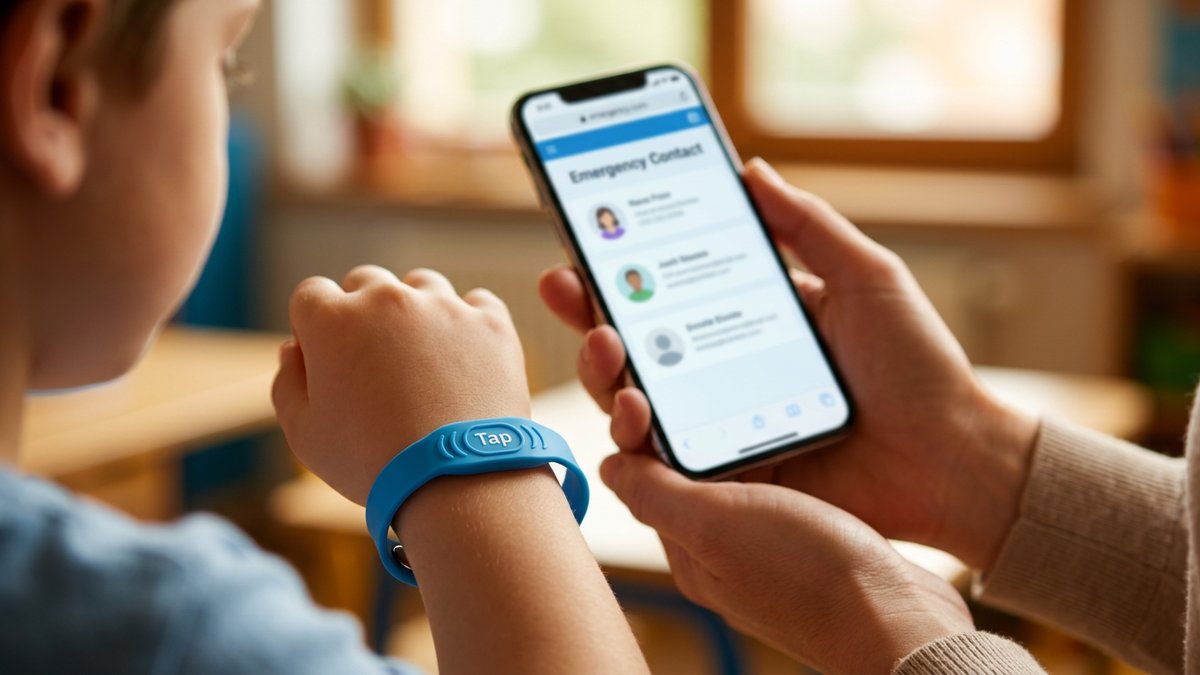
NFC stands for near-field communication. It is the same technology that powers contactless credit card payments and transit cards. Every modern smartphone - both iPhone and Android - can read an NFC chip without installing any application. When someone holds their phone near the wristband, a prompt appears on the screen. Tapping that prompt opens a webpage with the child's emergency profile. That is the entire interaction.
There is nothing for the teacher to install, configure, or remember. There is no account to log into. There is no signal required beyond the NFC chip itself reading against the phone - which means it works the same in a school building, on a bus, or at an outdoor event.
What the Teacher Sees When They Tap
When a teacher or substitute taps an NFC safety wristband, they see the information you have chosen to include in the child's profile. This typically includes:
- The child's name and a photo
- Parent and emergency contact phone numbers with direct tap-to-call links
- Allergy alerts and medical conditions, displayed prominently
- Any special instructions for medical events
- A note field where parents can add context relevant to the school year
The information is controlled entirely by the parent through a web dashboard. Updates take effect immediately - so if a phone number changes in January, the teacher tapping the band in February sees the new number.
Introducing the Tag to the Teacher Without Overcomplicating It
The simplest way to introduce a safety wristband to a teacher is to demonstrate it. At back-to-school night or during your initial meeting, show the teacher the band on your child's wrist and say: "If you ever need to reach me quickly, you can just tap this with your phone - it pulls up all of my contact information and her medical details."
That is a thirty-second demonstration that requires nothing of the teacher beyond awareness. You are not asking them to take on a task. You are showing them a tool that might help them one day.
Most teachers respond positively once they understand how simple it is. Some will ask follow-up questions about whether the school policy accommodates wearable technology. This is a reasonable question - and the answer is that a silicone identification wristband is indistinguishable in form from a plain bracelet and requires no school WiFi or infrastructure to function.
Coordinating with Specialist Teachers and Staff
Your child's day involves more adults than just their homeroom teacher. Depending on the school, a child may interact with a physical education teacher, an art teacher, a music teacher, a librarian, a reading specialist, a counselor, and recess supervisors - all of whom may be alone with your child at some point during the week.
Physical Education and Recess Staff
PE teachers and recess supervisors are statistically among the most likely school staff to encounter a medical emergency. Physical exertion can trigger asthma, cardiac events in children with undiagnosed conditions, and anaphylaxis if a child with a food allergy comes into contact with something unexpectedly. These staff members are often working with large groups of children across multiple classes and may not have your child's medical file memorized.
A brief introduction to the PE teacher at the start of the year - especially for children with asthma, exercise-induced conditions, or severe allergies - is time well spent. The same NFC wristband introduction works here: show them the band, explain that tapping it will bring up her medical details, and confirm that she should call 911 first and then you for any serious event.
The School Nurse as Your Ally
The school nurse is often the staff member with the most complete picture of a child's medical needs - but they are not always reachable in an emergency. Their office may be on a different floor, they may be with another student, or the emergency may happen off campus.
It is worth scheduling a brief meeting with the school nurse at the start of the year, both to ensure their records are current and to introduce them to any identification tools your child is using. Many school nurses are familiar with medical ID jewelry and NFC identification technology and can be advocates for the approach with other staff.
Lurie Children's Hospital's patient safety resources note that clear, accessible medical information is one of the most important factors in rapid emergency response. The nurse's support can help establish a culture where carrying accessible identification is treated as a normal part of school safety preparation.
Before Overnight or Multi-Day Events
School-organized overnight events - outdoor education camps, athletic tournaments, class trips - present the most complete break from standard school infrastructure. Chaperones and trip leaders may have very limited information about individual students, and access to the school's emergency systems may be nonexistent.
For any overnight or multi-day school event, confirm directly with the trip organizer that they have your contact information, know about any medical conditions, and understand how to use your child's identification wristband if needed. Do this in writing so there is a record.
Keeping Your Child's Profile Up to Date
An emergency information system is only as useful as the information it contains. A phone number that changed six months ago, a medication that was discontinued, or an emergency contact who moved away all represent gaps that matter exactly when you cannot afford gaps.
Build an Update Habit Into Your Calendar
The most effective approach is scheduling a profile review as a recurring calendar event. Many parents connect it to the start of each school semester - once in September and once in January - as a natural checkpoint that aligns with the rhythms of the school year.
At each review, confirm:
- All phone numbers are current and actively monitored
- Emergency contacts are still available and informed that they are listed
- Medical information reflects any changes in conditions, medications, or allergies
- The profile photo is recent enough to be a useful identifier
- Any school-year-specific notes are current for this term
For parents using a digital profile system, updates can be made in minutes. The information the teacher or substitute sees the next day reflects the change immediately.
After Any Change, Notify the Relevant Adults
When something changes - a new phone number, a new allergy diagnosis, a change in emergency contacts - do not assume that updating the digital record is sufficient. Send a brief note to your child's teacher and the school nurse as well. The goal is redundancy, not replacement. Multiple systems knowing the same accurate information is the strongest possible safety net.

A Template Message to Send Your Child's Teacher
Below is a message template you can adapt and send at the start of any school year. It is intentionally brief - a teacher reading this should be able to absorb it in under two minutes and feel genuinely helped rather than burdened.
Subject: Safety information for [Child's Name] - [Your Last Name]
Hi [Teacher's Name],
I wanted to share a few quick notes about [Child's Name] before the school year gets into full swing.
Emergency contacts:
- [Your name] - [Your cell number] (primary)
- [Second contact name] - [Their number] (backup if I am unreachable)
Medical notes: [Allergy or condition]. [What to do - e.g., "She carries an epipen in her backpack at all times."]
[Child's Name] also wears a small silicone wristband with an NFC chip. If you ever need to reach me in a hurry, tapping it with your phone will bring up her full profile with all contact numbers and medical details - no app needed, works on any modern smartphone.
I will send a quick note if anything changes during the year. Thank you so much - I am really looking forward to this year.
[Your name]
Feel free to adjust the tone to match your communication style with the teacher. The core elements - primary contact, backup contact, medical summary, and a brief explanation of the identification tool - are what matter.
The School Safety Coordination Toolkit
Bringing all of this together, here is the complete set of actions that constitute a thorough school safety coordination approach for the year.
Before school starts:
- Schedule a meeting or send an email to the homeroom teacher with your five key pieces of information
- Introduce yourself to the school nurse and confirm their records match your current information
- Identify specialist teachers your child will have regular contact with and plan a brief introduction
- Ensure your child's NFC profile or other identification tool is current and tested
At back-to-school night:
- Demonstrate the NFC wristband to the teacher if you have not done so already
- Confirm the teacher has a direct way to reach you during the school day
- Ask whether the school has a specific protocol for medical emergencies in the classroom
At the start of each semester:
- Review and update your child's digital profile
- Send a brief check-in to the teacher noting any changes
- Confirm emergency contacts are still active
Before any off-campus event:
- Contact the trip organizer directly with medical and contact information
- Confirm that at least one adult on the trip knows about your child's wristband
- Ensure your child knows what to do if they become separated from the group
Any time something changes:
- Update your digital profile immediately
- Send a one-line note to the teacher and school nurse with the relevant change
The parent who does this work is not being overprotective. They are being practical. Teachers and staff genuinely want to help your child in an emergency - and the parent who equips them to do so is making a meaningful contribution to their child's safety at school.

TapTap Buddy Team
Our team of child safety experts, parents, and technology specialists is dedicated to creating innovative solutions that keep children safe. With backgrounds in emergency response, pediatric care, and smart technology, we bring real-world experience to every article.
View all articles